
These are the new leads: The best sales minds in NYC share their wisdom next week
I can’t tell you how many times I’ve told startups to forget about raising money and instead to just go out and sell something. To me, if there’s any one area that New York City has a serious advantage in, it’s experienced salespeople. You can never have enough. They are the rainmakers—the ones who bring in the lifeblood of your company—cash.
But selling technology and digital media is a different animal. These aren’t dental supplies—this industry changes every single day. Given all the experience we have here locally, I thought it would be useful to put together a bunch of knowledgeable sales professionals to share what they know in a take aimed at full time sales professionals.
So, if you’re a sales rep, director, or VP selling digital media or technology in NYC, this event is for you, and boy have we assembled a murderers row of sales experience here.
The event will take place next Wednesday night, December 9th at 6PM at 111 8th Avenue at Deutsche Inc.
They’ll be talking about what they did to get to the next level... ie. was there a turning point in their sales career and when did things came easier... when did they "get it" and when did they really break through. They’ll also cover what kind of training and methods worked for them, what didn’t and the things that maybe go against commonly accepted sales wisdom.
Here’s the lineup:
John Roswech, President, Jingle Networks
Prior to joining Jingle Networks, John Roswech served as vice president of sales for Atlas Solutions (Aquantive), where he managed sales and account management teams for third party ad serving, search, rich media and landing page optimization, with revenue growing $100mm plus under his sales leadership. Before Aquantive, Roswech was senior director of sales with Matchlogic (Excite@Home), where he was part of the management team at Narrative Communications and responsible for rich media and lead generation products.
Jed Savage, Chief Revenue Officer, ScanScout
A twelve+ year Digital Media Sales veteran, Jed was the Director of Business Development for eBay’s Strategic Partnerships unit before joining ScanScout. He served for 4 years with Microsoft’s MSN division, holding positions including Eastern Sales Director, National Sales Manager and General Manager of MSN Sales. Jed increased revenue 10-fold in his first two years at MSN, and helped make the MSN sales division one of the leading revenue organizations in the industry. Before working with MSN, Jed created the National Sales Team for CBS Sportsline. As the company’s Vice President of Sales his team drove over $30 million in total revenue during his first 2years at the helm.
Jeff Stewart
Jeff is the founder of Urgent Career, a pioneer in the use of linguistic technology to match sales professionals with compatible employment opportunities. Jeff has founded over a half-dozen companies, which combined employ over 600 people. Immediately prior to founding Urgent Career, Jeff founded a technology-based financial intelligence firm that provides real-time analysis of semi structured text information for Hedge Funds and other Institutional Investors. The seeds of Urgent Career grew out of the observation that semantic analysis of massive amounts of textual data yields valuable insights.
Emily Twomey, SVP Sales, Oddcast
Emily has over ten years of experience in online media sales & interactive product sales. Prior to her position at Oddcast she held the positions of Director of Sales at Razorfish Networks and Senior Sales Manger at The New York Post. She started her sales career at the downtown style bible PAPER Magazine.
Mark LaRosa
Mark LaRosa is the CEO of QuotaCrush, a sales consulting company focused on helping start-ups with sales strategy and outsourced sales management. In its first year, QuotaCrush has brought two start-ups from zero sales to break-even – in a horrible economic climate. Prior to QuotaCrush, Mark was also the founder of Dynamic Mobile Data, a wireless enterprise software company focused on vehicle location and dispatch software. Mark sold over $20 million in enterprise software in this startup to companies including Pepsi, SHL, UPS, Purolator Courier and Kraft/Nabisco.
Vivek Sharma, Former Area Mgr., North America - Engine Yard
Vivek is currently working on a stealth startup, but he most recent ran the sales team at Engine Yard that covered the eastern part of North America and EMEA. He was the second salesperson in the company and best performing regional manager in 2008 and was on track for similar success in 2009. In 2008, he brought on nearly 40% of Engine Yard's net new revenue and closed the largest deal ever in the company's history. )
Is Plancast Foursquare in the future or just Dopplr? Perhaps it’s the event tipping point we’ve all been waiting for.
In our completely tiny world of the Web 2.0 echochamber, Plancast is blowing up after some good Techcrunch coverage. (BTW… is it me or does MG Siegler class that place up like tenfold?)
So what is it?
Plancast is a place where you can share what you plan on doing in the future. Tonight, I’m planning on going to the NY Tech Meetup, and so using Plancast, I was able to let anyone who cares know about it—and tweet it out as well.

Plancast has a non-bidirectional follow, just like Twitter—which means you can find out about my events but I don’t need to hear where you’re going to be. That’s very powerful because it opens up the number of possible connections in the system.
What’s really interesting to me is that I’ve been talking about the scheduling and event issue with a number of people who are working on it. Why everyone is suddenly working on scheduling, I have no idea, but there are a number of different takes on it. There’s BuddyBlip and tym.ly as well, and I’m sure a number of other people are working on it.
At first, when I saw Plancast, I thought of Dopplr. Tons of people signed up for it, and people kept posting to it to varying degrees, but it never quite crossed the chasm. It’s a perfect example of a startup that showed solid initial traction, but sputtered when it tried to get past the tech community. One reason is that it kept all your future plans locked away. There was no broadcasting to other networks, and so there was very little virality and discovery by outsiders. Even so, Dopplr didn’t really change my behavior much. I sort of felt like, “Great, so you’re going to be in Denver…” If I wasn’t going to be in Denver at that time, it wasn’t useful to me. In fact, because it was all about big trips, most of the info, by definition, was never going to be that useful for me.
Plancast solves that problem by making it about the small stuff—the stuff I could actually tag along for and participate in. That makes it infinitely more useful to me—but let’s keep in mind that I’m not every user. To cross the chasm, you have to get past the people with almost 5,000 Twitter followers (should I get a cake?), and those folks, like my mom, don’t attend nearly as many events, nor do they want to broadcast it to the world.
Being the Tipping Point
Solving this, however, is where Plancast could be potentially awesome, if this is the way they want to go… and here’s how. If I’m Plancast, I’d strike deals with Facebook, Meetup, Eventbrite, Evite, Pingg, Upcoming, etc… and I’d focus on becoming the event “Tipping Point.” A browser plugin or link would effectively work the same way. Basically, you’d want a button or checkbox that recognizes that there’s an event on the page, and broadcasts a message to my friends that I’m interested in going.
By allowing me to curate which events I blast to my social network, you’re creating a stronger signal than just hitting maybe, ignoring it, or sometimes even hitting yes. You’re telling the world that you’re going and that you’d like people to come with you. There’s a huge problem, particularly in Facebook and Meetup events where no one ever wants to be the first one in the pool. For whatever reason, in Facebook they hit yes but never show up, and in Meetup they just tend to ignore the invite. A lot of these people would actually go if they knew their friends were going, so Plancast could seriously up the response rates and actual followthrough on attendance for events. By encouraging others to go, and informing me when other friends sign up, it pushes the event over the tipping point, which is potentially very powerful.
This would work well not just for the Web 2.0 crowd, but for the soccer moms in closed little groups of close friends publishing their intention to to go the next Wiggles concert to each other.
Not only that, it begins to aggregate the information on what I go to across event platforms, learning a lot about my interests and being in a position to offer new events to me—so there’s your business model, kiddies.
Of course, maybe this isn’t where Plancast wants to go—and maybe they’ll just wind up being another Dopplr—a sad reminder of what could have been. I have a feeling that won’t happen though. They seem to have a lot more user centric DNA to them, and I love their publish everywhere, open strategy.
One thing they definitely need to do, though, is make it so I don’t have to manually input all my future events—like I said either with a browser plugin, or by allowing me to sign in and sync with all of my various event accounts. Heck, they could even publish this stuff to my Gcal automatically—but that might be a bit of feature creep. They’d have to let me have the choice as to which events I want to publish to the outside world, though.
I’m looking forward to see where this one goes… it’s really interesting.
To Poach or Not to Poach: Hiring and Retaining within the Startup Community
Just the other day, an entrepreneur I know asked me what I thought of a recent hire going from one startup to another—and the “aggressive” fashion in which that person was recruited.
This is a touchy subject—way more than it ever is within the big corporate community. There, it’s much more about competition. When you’re talking about folks you may have started with when your team was just a handful of people, it can easy get personal—both between the exiting employee and their company, and among entrepreneurs.
I basically follow two rules of thumb when it comes to these situations:
“No one takes your employees from you, you lose them.”
and
“Don’t hire anyone with baggage.”
If someone is able to hire away one of your employees, that means you haven’t created an interesting enough environment for them to work in, or one that looked promising enough for them to stick around in. If it wasn’t that company they left for, they probably would have left for someone else soon enough. It’s easy to demonize the person who hired them away, in the same way that people who get cheated on tend to hate “the other woman/guy”, but the reality is that the blame starts in the mirror. At my own company, we had an employee whose background was extremely highly sought after, and I know she got several offers. I even know which startups made those offers and I can’t blame them. She was pretty awesome. However, she stuck with us nearly until the end of our fulltime status at the company, which is more than I ever could have asked for—and I think that’s a testament to the kind of relationship we built over time. It was a relationship based on a clear shared vision, fairness, and open communication.
At the same time, each employee really needs to do what is best for them—so it’s really not about one company “stealing” from another company so much as it is employees optimizing for whatever priorities they have in their life. We don’t have guaranteed employment from employers, so employees don’t realistically owe any “extra” loyalty to the people they work for. This is still business, despite all the blood, sweat, and tears that teams put into their startups. However, that doesn’t mean a free for all is good either. We all need to play nicely in the sandbox, because you never know when you’re going to need someone else’s help.
When I say not to hire anyone with baggage, I think you really want to make sure that anyone you bring on has been as forthright as possible in dealing with their current employer. You should always ask about that if you’re about to hire someone—and insist on openness from the person you’re trying to recruit. If they’re unhappy, it should come to no one’s surprise. If they have other goals, they need to be communicated to the employer. Sure, no one likes to see a good employee leave, but there’s no reason why you can’t know that it’s coming ahead of time and make the appropriate plans around it. If you know that your top dev is looking for more of a challenge—one you can’t provide—then not only should they be able to tell you, but also you should be supportive of their search. Not only is the open and honest feedback about their situation helpful and informative to you as an employer, but you want to make sure your company has a supportive, not vindictive, reputation in the market. People switch jobs. It happens. The worse you treat your former employees, the harder it will be to recruit new ones.
So, when I hear the word “poach”, I cringe a little, because I think it misses the point. That employee was gone way before the offer was made, but unfortunately, internal communication is often very poor *on both sides*, which often leads to bad blood and negative buzz in the market around your company.
First Round Fridays – Deck your ecommerce halls with Monetate to drive sales
 Abandoned shopping carts getting you down on Black Friday? Pay per click ad campaigns not converting to more purchases? Perhaps that’s because you spent all sorts of time customizing your AdWords text, your direct marketing newsletter, and adjusting the wording on your display ads, but yet you’re driving all of your customers to the same site with the same messaging and offers.
What Monetate does is to allow any site to easy and dynamically create a post click marketing solution with a single javascript tag. You can add new content to pages, overlay content on other elements (like sale tags) and render dynamic text in creative. Sites have shown substantial ability to boost conversion, increase revenue, and decrease abandonment.
So this way, when I find your site because I clicked on the “Hats for bald dudes” PPC link on Google, you can dynamically change all the ads to show bald dudes in hats with attractive women checking them out.
Of course, I wouldn’t be searching for that, because chics seem to dig the shorn dome, but you know, some guys out there are still doing the hat thing and haven’t fully embraced the shine. That kind of display would certainly increase conversion of that particular customer.
I love the tagline on their site: “You work hard to drive traffic to your site. Don’t waste it.”
Services like Monetate that improve the overall shopping experience are particularly interesting to me. I think retailers are realizing that the web allows them to analyze, personalize, and compliment their existing offerings in ways they never had before—and that if they don’t take advantage of this now, they’re going to get steamrolled. This is the kind of technology that Amazon has been perfecting for years—and now any online seller or marketplace can take advantage of as a service.
Obviously, I’m biased because this is a First Round investment, but if I’m selling anything, I can’t see a reason why I wouldn’t give this technology a shot. That is, unless, you’re absolutely satisfied where your conversions and revenues are and wouldn’t want to see them increase. If you’re curious, check out their “Lift Without Loss” whitepaper.
Will the Ace Hotel embrace the innovation community?

Almost overnight, the Ace Hotel lobby has become something of a phenomenon. On any given day, you’ll run into an actor, a fashion designer, a model and—randomly enough--an tech entrepreneur.
Just this week, as I was taking meetings in my relatively new role on the First Round Capital investment team, I got to meet Charlie Rose, spotted Tobey Maguire, and most notably, Boxee’s Avner Ronen and Jetsetter’s Drew Patterson.

With a long study hall style table, comfortable couches, and wifi whose codes are the worst kept secret since USV’s Foursquare funding, the Ace had attracted a growing following from the New York City startup world. The Stumptown Coffee right off the lobby doesn’t hurt the geek pull either—everyone knows high quality caffeine is the fuel that makes code go.
I discovered the Ace Hotel thanks to a coffee invite from Nick Bilton. As it turns out, Phin Barnes, my colleague at First Round had known about it for a while, and on any given day you’re likely to run into one of us taking meetings with entrepreneurs here.
The question is whether the Ace Hotel will embrace its newfound friends in the Big Apple’s creative class. While the waitresses aren’t pushy with getting people to order—yet—little cards have started showing up reminding folks that these seats are “guest only”. I’ve yet to find a guest among the Ace’s laptop nation yet, but I’m currently sitting within spitting distance of Malcolm Gladwell as I write this. I’m pretty sure he’s not staying at the hotel either.
There’s certainly an argument that attracting the local tech scene’s “cool kid” crowd, like Zach Klein, who I ran into the other day and passed on an office space tip to, is good for business. Being community friendly will help the Ace become the go to place for innovators from the creative class. I mean, wouldn’t you like to be the place where the next Google or Facebook was hatched? That’s especially the case since many of the young innovators are also the trendsetters in music, food, clothing, etc. I doubt anyone wants someone to build a router at the study hall table at Ace, but they should certainly extend an open invite for Anthony from Hype Machine to come hack here with his tech team.
To look at a similar story, you can go back to when the local NYC tech community adopted the Shake Shack in Madison Square Park as its unofficial social hub. That’s a good example of a business totally embracing the community. Mentions of the Shake Shack on Fred Wilson’s blog date back to the summer of 2004, when foodie entrepreneur Joshua Schachter and del.icio.us had a little office at 915 Broadway. Since then, the venue has hosted two of the best tech events in NYC and an epic snowball fight that featured Shake Shack employees participating and free hot chocolate.
The Shake Shack further fostered their relationship with the local tech community by letting a couple of hackers claim and build off of the @shackshack Twitter account. By powering it with a retweet bot, they created a way for local “insiders” to skirt the line by seeing who they knew was already there. Now, much of that functionality can be found on Foursquare, but still, the fact that the folks from Danny Meyer’s burger paradise in the park didn’t attempt to block the account speaks well to the kind of relationship they want to have with the community.
So the question is, will the employees from the Ace Hotel be ready for the West 29th Street snowball fight with local entrepreneurs or will we soon get booted for being wifi and table moochers.
Video from last year’s Shake Shack snowball fight.
UPDATE: I got this message via the little Plugoo chat window on my blog:
“ACE NEW YORK LOBBY SIGNS > "Thanks for pointing this out. We want to balance the needs of our guests & the community - both are very important to us. NY lobby signs are down & we hope this flows naturally & organically. – Ace”
That’s really the best response I could have gotten. It makes me want to go there more and to make sure I’m spending a little money and recommending them, too.

This Week in New York Tech - November 23rd
If you haven't been getting this in your e-mail, go here and sign up.
LET THESE NYC STARTUPS MAKE YOUR HOLIDAY WEEK!
While this will be one of the quieter weeks in the NYC tech scene, no doubt that it's going to be one of the most hectic weeks at home. You're probably hosting, cooking, and shopping (and drinking), so why shouldn't the internet make your life a little bit easier and more entertaining this week. I've picked out a few local companies that might make this the best Thanksgiving week ever.
I did find free jazz on the (covered) rooftop of the Empire Hotel tomorrow night, which looks like a pretty cool thing to do.
First off, you can't host a great party without inviting anyone, so Pingg should be your first stop for party invites. They wrote up a piece for all the T-day hosts out there that you should check out.
Before all the festivities, you should definitely make the traditional trek to the Upper West Side to see the Macy's Thanksgiving Day parade floats get blown up. Who else is going to be there, though? How will you find them and share the experience? Hotpotato, a First Round portfolio company, just got back from launching at Crunchup and should be up and live in the app store by the time the first bit of helium makes its way into Snoopy. Share photos, notes, etc., with others in real time all around this annual event.
Meals are going to be pretty standard--turkey, stuffing, etc.--but make sure your wine selection isn't. Check out Snooth.com for the best recommendations from the most comprehensive wine database in the world.
What on earth are you going to wear? Try out a bunch of outfits and ask your friends to vote on the most appropriate ensemble with Fashism. If you're like me, you can barely dress yourself, so this kind of thing is best left to crowdsourcing.
Men, you will undoubtedly spill wine, gravy, and cranberry sauce on your white shirts, so come this Friday, it's going to be time to go shopping for a new one. Don't just buy one off the rack. Customize and personalize your own unique dress shirt with Propercloth, another cool NYC startup.
You've made way too much food and will undoubtedly be eating turkey between now and 2015. Looking for the best recipe to mashup the leftovers? Look no further than this week's Food52 Turkey Leftovers contest. I feel like that one is going to be a win-win all the way around.
Enjoy your holiday!

Is more business getting done on Twitter than on LinkedIn? One reason why…

People who actually know me recognize the image to the left as my avatar. They might not know what it is, but they know they see it across many of my various profiles and instant messenger accounts. It’s actually the screenshot of a Voki character that I created—a little bald dude with headphones in front of a baseball, surrounded by a fireball. It’s meaningful to me because I was the Director of Consumer Products at Oddcast when Voki was launched.
Fred told a similar story this week about his avatar:
“I began to use it a bit here and there around the web as I set up new profiles. But by no means was it the only profile picture I used. For corporate oriented services like LinkedIn, I'd use my Union Square Ventures headshot. For social nets like Facebook, I'd use a regular headshot. I used a photo of me taking a photo on Flickr for a long time.
But then I started to realize that the Wallstrip avatar was becoming my online identity. People would comment about it all the time. Around the time we sold Wallstrip, Howard asked Jenny to do a real painting of it which I now have in my office at Union Square Ventures. It's a real conversation starter.
Sometime in early 2008, I just decided to go with it everywhere. It's at the top of this blog and everywhere else I have an online identity. It's my online brand now.”
One of his commenters agreed: “thats how i recognize the Fred Wilson brand online.”
The key here is that, by making our online interactions personal, Fred and I are creating a brand for ourselves that has real business ROI. Followers of my blog and my Twitter account know that I bike, play softball, and kayak. They’ll joke with me about my taste for heavy industrial music, and they don’t mind so much the occasional snark I use in my writing, because when you deal with me professionally, you get Charlie O’Donnell the person, not just the resume.
It shouldn’t be any surprise, then, that I think of my online presence as my most important business asset—and that I conduct a lot of important business through these casual and personal channels.
That’s also why, more and more, LinkedIn is becoming less of a place of business for me, and more like a static rolodex. At the end of the day, LinkedIn just isn’t a place where I want to spend much time. I don’t engage in nearly the kind of interesting back and forth that I do on Twitter or on Disqus comments either on my both or that of others. It’s just a well connected rolodex of over 1300 of my best contacts… but in the grand scheme of things, I’d rank it a distant fourth in terms of my most important online profiles behind my blog, Twitter, and Facebook.
So when I got notified that not only had LinkedIn removed my avatar, but had revoked my photo privileges, I was pretty stunned. They told me that “as a professional networking site” they give users the opportunity to upload a photo to assist other members in recognizing me.
Actually, I don’t need photos to help others remember who I am—because I only connect to people that already know me… and tend to know me pretty well. If you just saw my bald head at a conference and that’s all you have to go on, I’d rather you didn’t try to connect.
On top of that, LinkedIn’s language of photo “privileges” and giving me an “opportunity” is a rather interesting choice of words for a site that depends on its users’ content and active use of the site to upload their contacts to produce revenue. If anything, LinkedIn should be thanking me for the privilege I gave it to monetize my network, instead of reprimanding me for improper use of the “opportunity” it gave me like I was a child. Furthermore, who are they to tell me what acceptable professionalism is online? Clearly, over 1300 people find me acceptably professional. If they didn’t, they wouldn’t connect to me. How about removing all of the privileges of random people who don’t know me and try to connect.
I’ve been an active user of LinkedIn for years—advocating its usage and teaching about it up at Fordham. There are lots of things I wish it did—like helping me actively monitor relevant changes in my network or having better group tools. One problem I did not have, nor did anyone else, was too many people putting up avators or corporate logos as their image. It’s not a complaint you hear about Twitter—that the site is unprofessional because people don’t use their real pictures. LinkedIn may not care about how people conduct business now online—it’s making too much money selling access to my profile to recruiters. However, things have changed. More and more people are gathering in more friendly, social places online around common interests outside of their career and getting more business done like that than on a buttoned up resume site. Policing photos and reprimanding users that other users want to connect to shouldn’t be a priority for LinkedIn if it really wants to be the kind of place that up and coming professionals want to spend any time in.
Congratulations to the future Mr. & Mrs. Cuthbert

My best friend since 1st grade just got hitched in Central Park.
First Round Fridays: BigDeal.com launches competitive shopping site
 Yesterday, I bought an Xbox off of BigDeal.com, one of our First Round Capital portfolio companies. I spent nearly an hour and a half bidding against some guy to try and buy at increments from about $18 all the way to $168. I tried every strategy I knew… holding out to the last second to try and lull him into a sense of security and then jump in… then brute forcing it by counterbidding every second all throughout the $30 and $60 range to try to wear him out. It was an addictive bidding frenzy—and my downside was just buying it at the Amazon price, so I couldn’t really lose. (I didn’t win, but I’ll be back!)
TechCrunch did a good job of covering the company yesterday, so I’ll just pull the highlights:
“BigDeal lets users purchase virtual bids $0.75 each which can then be used to bid on goods ranging from video games to high-end televisions. Whenever you bid on an item, its price increases by $0.15 and an extra 30 seconds are tacked on to the duration of the auction. With this model, items end up selling substantially below their market value. But one of the main criticisms of Swoopo was the risk of losing your money spent on bids (regardless of whether you win or not) when the auction concludes. BigDeal takes a couple of steps to mitigate this risk.
With BigDeal’s model, any users who get outbid get a full credit of the money uses for bids to buy the item via a “Buy Item Now” option (which Swoopo also has, called “Swoop-it-now”). So if you spent $10 on bids, your Buy It Now price will be dropped by $10. Of course, the Buy It Now price will frequently be higher than the price of item sold for in the auction but at least users aren’t necessarily losing money all together. And the Buy It Now price is set at the same price that Amazon lists for the same product.
That’s not all. BigDeal provides an added incentive for bids by letting all users trade in the money they spent on bids for gift cards. All users get $1 gift card discount for every $1 spent on bids. So if you buy $25 in bids, BigDeal will give you a $100 gift card for $75…
…It seems that Big Deal has taken the best elements of Swoopo’s model and added several features which make it more of a win-win for consumers. Plus, it adds information, like bidding history, to the process to make the auction more fair.”
I’ll be interested to see how the company works towards providing more and more auction transparency. Admittedly, when I bought my Xbox, I didn’t realize that I wasn’t getting my bid points back when I took the “buy it now” price. I thought everyone was seeing the same price, like a loaded gun on the table, and that everyone’s bid lowered it. I figured everyone else’s lost bids were subsidizing my price, but as it turns out, I didn’t really get “refunded” my points back—they just came off the MSRP. So, I effectively just paid the MSRP price… not what I wanted, but not a terrible outcome, since it’s been years since I had a game system and I was kind of itching to get back into it. Perhaps I’ll bring it to the new First Round offices in Union Square (coming this January) and we’ll have entrepreneur Madden tourneys!

Thinking about going from Employee #23515 to Employee #5? nextNY MatchupCamp
 I've been thinking a lot about where entrepreneurs and startup talent come out of in NYC. A lot of folks believe that you can train people coming out of the financial services base to do something entrepreneurial, but honestly, I'm not so sure about that. What I do think, however, is that it takes more than just a visionary leader or a ninja-level hacker to start a business. There are tons of startup companies in New York City, many already making money or well funded, that are looking for top supporting talent--engineers, designers, salespeople, business development pros, product managers, etc. This is where we, as the startup community, can do a better job--mining the installed base of talent in big companies. I'm actively looking for ideas on how to tell the masses of talented, experiences folks slaving away in Cubeworld that there's a thriving innovation community in New York City with lots of great companies looking for talent. How do we pick apart the CondeNasts, JP Morgans, and Time Inc's? Please talk to me about it. If you're a recovering Fortune 500 employee, tell me how you got out. (charlie@firstround.com) One way the nextNY community is trying to help is with Matchup Camp.
MatchupCamp is for skilled professionals to find new opportunities—for developers to find inspiring projects, for salespeople to find interesting products to sell, etc. It’s not a bunch of unemployed people handing out resumes. It’s for people looking to explore where they might best fit. When we did this two years ago, technical talent probably made up 40% of the crowd and we’re working hard to make sure it’s not just people with ideas, but people who can make them happen.
When: December 8th at 6:30
Where: FYI Studio 22 West 27th, 6th Floor
Launching my weekly e-mail notes on the New York innovation community
Wow… what a long way we’ve come. In February 2006, I started nextNY because the only community-wide event in town was the NY Tech Meetup and, at the time, it didn’t have much community about it. I think I was member #71 and now it’s got over 10,000. At the same time, the NY tech community has exploded with events, both educational and social. One look at GarysGuide and you can get quickly overwhelmed.
A number of people asked me at recent nextNY events how they can find out about what’s going on. Pointing a busy entrepreneur or executive to the nextNY listserv, which buzzes all day with discussion of memory caches, CMS’s, and finding a bookkeeper clearly isn’t the answer.
Therefore, I’ve decided to take the attendee lists from the last two Shakeshack events and some recent nextNY talks and start a once a week e-mail newsletter as a curated version of what’s going on around town and in the online communities as well. In the future, I’ll also be highlighting some open job positions, maybe some companies, and maybe just some recommendations on people that you should follow. If you’d like to sign up for the list, just go here. It’s going to look pretty texty and unformatted for a bit, but I’ll dress it up soon.
Event of the Week:
The Net Neutrality TechDebate, an Oxford style competitive back and forth on what is probably the most important topic in technology today that few of us have a clue about.
The debate will be held on Tuesday, November 17th at the IAC Building, 555 W 18th St btw 10th & 11th ave. Doors open at 7:00 PM. **RSVP here**
The Debaters
Against
James Assey - Executive Vice President, National Cable and Telecommunications Association
Robert Quinn - Senior Vice President-Federal Regulatory, AT&T
Christopher Yoo - Professor of Law and Communication; Director, Center for Technology, Innovation, and Competition, UPenn Law
For
Tim Wu - Coined the term "Network Neutrality"; Professor of Law, Columbia Law
Brad Burnham - VC, Union Square Ventures
Nicholas Economides - Professor of Economics, Stern School of
Business, New York University.
Can't make it?
The debate will be streamed live at: http://www.livestream.com/techdebate
A podcast will be available after the event at: http://tech-debate.com
Would rather drink?
Check out the NYVC Happy Hour instead.
=========================================
This week is O’Reilly’s Web 2.0 Expo at the Javits Center. By registering for an Expo Pass, you can get in free to see all the keynotes, the sponsored sessions, Web2Open, Launch Pad, and the Birds of a Feather sessions.
Here’s what you won’t want to miss:
Monday
Ignite NYC – 5 minutes, 20 slides. Geeks + Slideshows = Awesomeness
7PM at New World Stages: 340 West 50th Street
Tuesday
2PM: A Conversation with Caterina Fake Jennifer Pahlka (Code for America), Caterina Fake (Hunch)
2:25PM: Streams of Content, Limited Attention: The Flow of Information through Social Media danah boyd (Microsoft Research)
Wednesday
2:20pm A Conversation about the Realtime Web Brady Forrest (O'Reilly Media, Inc.), John Borthwick (betaworks)
Thursday
9:15am A Conversation with Beth Noveck Tim O'Reilly (O'Reilly Media, Inc.), Beth Noveck (Executive Office of the President/OSTP) <—Yes, *the* President
=========================================
It’s also Entrepreneur Week and there are a couple of noteworthy panels. Unfortunately the event is sold out, but there will be a livestream available on their site soon.
I think the pick of the conference is this panel at 2:15PM on Thursday:
The Revenue Inflection Point: The New Reality of Scaling a Business to $100MM in Revenue
MODERATOR: Bob Tedeschi, New York Times Technology Columnist
PANELISTS:
Stephen Messer, Co-Founder of Linkshare
Omar Amanat, Entrepreneur in Residence, Wharton School of Business
Marc Cenedella, Founder & CEO of TheLadders.com
Nancy Pedot, Former CEO of Gymboree & Party City
Chris McCann, President of 1-800 Flowers.com
Also right up there is this Friday panel at 10:30AM:
A Roadmap for the Entrepreneur Pt. 2: Top Venture Capitalists Reflect
MODERATOR: Murat Aktihanoglu, Founder of Centrl & Entrepreneurs Roundtable
PANELISTS:
Albert Wenger, Partner at Union Square Ventures
Jim Robinson, Co-Founder & Managing Partner of RRE Ventures
Anthony Marino, Managing Partner at Virgin Investments
Howard Morgan, Partner at First Round Capital
=========================================
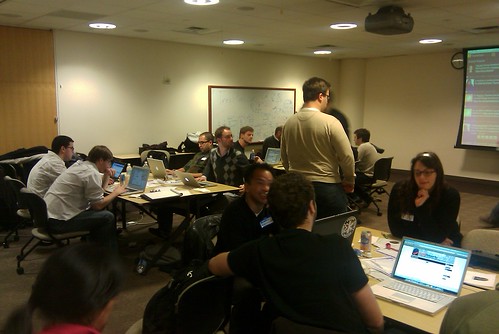
This weekend is Startup Weekend. Startup Weekend recruits a highly motivated group of developers, business managers, startup enthusiasts, marketing gurus, graphic artists and more to a 54 hour event that builds communities, companies and projects.
David Kidder will be speaking Friday night while Nate Westheimer, Sam Lessin, and I will be on the Sunday night panel.
First Round Fridays: Pimping out your friends with Thread
 Last week, First Round Capital had its annual meeting, where we got to walk through our portfolio with our investors. Honestly, I didn’t realize how many cool companies we had invested in, so I’m going to take the time each Friday to highlight another company.
Since I got a “One of Josh Kopelman’s friends likes your photo” note from Thread yesterday, that’s going to be today’s spotlight.
Thread is a pretty simple concept: Meet people through your friends on Facebook. Now, conceptually, meeting people through social networks is a good idea—but we all know how unappealing setups can be. Thread enables you to get proactive about searching your friends’ networks while minimizing the effort and risk they put in as a middleman.
What I really like is the anonymizing features of the site—where someone can reach out to you, but they’re shown to you in a group. You only get matched when there’s mutual interest. That keeps down the awkwardness of a turndown should you ever meet in person. For all they know, you just don’t check the site. This works a little like those “One of your friends likes you” viral sites from the late 90’s, but now you’ve got the assurance that there’s a real human behind the interest.
The site could do a little better job learning about my preferences and keeping me searching for more people, but overall, it’s a pretty solid concept and execution. So, if you feel like you’ve got a pretty good network of single friends, but don’t really want to get too involved with matching people up, let the interwebz do all the heavy lifting and sign up for Thread. You can just sit back and reap all the social capital.
I don’t know who I just helped, but it made me feel good: Plugoo Randomness
[My Plugoo] [grr] how do i no if my my dog is dying
12:38 PM
[grr] she is only 4 months old
12:39 PM
[grr] hello plz i need an answer
ceonyc12:39 PM
Take her to the vet.
myplugoo12:40 PM
[grr] i done have enough money
ceonyc12:41 PM
Most vets will at least look at a sick animal for free if you really don't have enough
12:41 PM
it's worth a try... I can't see them turning away a sick animal b/c you can't pay
myplugoo12:41 PM
[grr] she breathes weird she doesnt want to move a bit and will a few days ago she took a little totsie roll out of my hand
ceonyc12:42 PM
chocolate is very harmful to dogs...you should take her to the vet
myplugoo12:42 PM
[grr] i should
ceonyc12:42 PM
Yes... worry about the money later
myplugoo12:42 PM
[grr] ok thx
ceonyc12:42 PM
no prob
myplugoo12:42 PM
[grr] will bye
Chasing Innovation and Steak in New York City
There are certain realities behind venture capital one cannot escape from:
- At the end of the day, the more of the best companies we own, the more money we make.
- We don’t always know which companies will be successful, but if a bunch of other smart people think that a company has promise, there’s a good shot we’ll want in.
- We don’t always want to get off the merry-go-round the same time the entrepreneur does—and often times we want to go around again, at twice the speed.
Fortunately, some firms, like the two that I’ve been fortunate enough to work for, Union Square Ventures and my current firm, First Round Capital, understand the following:
- Owning less of *more* great companies works just fine, too—especially if that means you’re left with highly incentivized entrepreneurs who receive appropriate amounts of financing at the right time, focusing their efforts.
- We should strive to be *the* smart people that other people want to work with—by working hard to get smarter about the areas we invest in.
- At the end of the day, smaller funds can deal with the “high class problem” of the $100 million exit just fine, because we don’t need a billion dollar exit to make our find economics.
But why do I like working with startup companies?
I think that’s important for someone to understand when pitch their idea or project and agree to take on an investor. I’d encourage every entrepreneur to ask the people that they’re pitching to, “Why do you do this?”
Some people are deal guys (or girls). Always be closing—they love the transaction. They just like having money behind them and putting it to work. The bigger the deal the better. They’re tough negotiators and they like pushing the envelope on how much they can get. It’s a money and power thing. Their steak dinners are outlandishly full of more food than anyone can actually eat. Perhaps they were salespeople or bankers in the past. I’m definitely not that guy.
Other people are all about having better toys—getting into the hot deals. They need the fastest, the best, the smallest, and their stuff is better than yours. They don’t just order steak—they order the super secret cut of Kobe steak that was grass fed by albino ninjas wearing a certain kind of slippers. They’ll wait until the train looks like it’s leaving the station and then they’ll come swooping in, absolutely needing to push their way in because they need to have it. I’m not that guy either.
Me?
I think I’m two things. First and foremost I’m a relationship builder. I doubt you’ll find someone in NYC who knows as many people in the innovation community as I do—simply because I love it. (And PS… there’s still a few thousand of you I haven’t met yet!) I love meeting and getting to know interesting people—and venture capital just happens to be an industry where you’ve got unparalleled incentive to make a habit of this. Plus, this is a self-selected group particularly high in awesomeness. Maybe that’s why steak is celebratory food for me. My best friend of 24 years and I take each other out to top tier NYC steakhouses for our respective birthdays. Sure, we love the food, but it’s really all about the person on the other side of the table—and it’s the same with startups. The people on the other side of the table over the last 6+ years have been amazing to work with.
Second, I’m a systems designer of sorts. I like thinking about how data and other elements flow through a system and produce outcomes. It’s the way a portfolio manager constructs a pool of assets within certain constraints. It’s fascinating to me to try and take the randomness out of the equation and to try and figure out where the startups are coming from, what kinds of people are building them and what is making them successful—to turn those learnings into a strategy with actionable criteria, filters and decision points. What that means is that I’m trying to figure out whether the waitress at Del Frisco’s is actually flirting with me or whether she’s systematically making every dumb guy like me feel like they’re special to get a better tip—and what percentage increase that generates in her net pay. These are the kinds of things I’m thinking about.
Lastly, I have this teaching gene. I take a lot more pride in the success of others than in my own. When I play softball, I could get 4 hits in a game and not be nearly as excited compared to when that girl who never gets a hit drives in her first run after I taught her how to swing. Now, granted most of the entrepreneurs I meet wind up teaching me more than I could ever teach them, it still means a lot to me to be able to help someone achieve success. It’s kind of like introducing someone to the crabcakes at Ben Benson’s—it’s great to be able to help someone have a great experience like that.
And as a bonus, another driver of why I love working with startups is my New York City pride. I was born and raised here and love when people find what they’re looking for here—success, inspiration, a challenge, or just a good sysadmin.
For the record, I’m not as big of a fan of Peter Lugars or Sparks as others are, and Del Frisco’s remains my favorite. Other solid choices are Old Homestead, Wolfgangs, Angelo and Maxies and Strip House.
Where’s your head at? A good example of an entrepreneur thinking about the right stuff
I just got off the phone with an entrepreneur that hit all the right points…
- Followed up on a small idea to figure out if there were any customers for his service—turned out there were more than expected.
- Worked with other startups to figure out proxies for the set of most demanded features and compatibilities—and made a plan to offer them.
- Got up and running right away—and on the cheap—to start testing the service.
- Crashed the service several times with early alpha users, leading to improved product.
- Almost as immediately, went out and started talking to all of his potential competitors, finding out where this service was on their roadmap. Even found a way to derisk competitive threat by thinking about ways to work with them.
- Now that he’s done research and has initial customer validation, he’s raising just enough to get to the next milestone—to figure out what his business strategy will be out of a limited set of scenarios that he’s narrowed down to. This will be dictated by real metrics like cost of acquisition, sales cycles, margins and capital requirements.
Color me impressed.