Public Stealth Leaves Opportunity on the Table. Working in Secret is Even Worse.

“Too many secrets.”
I stopped making new investments out of my fund, but I’m still a gatekeeper of sorts. I run conferences like the Pre-Series A Offsite, VC/Founder Coffee Meetups (like the ones happening next week), and Open Office Hours, where founders are getting intro meetings with investors this week thanks to our tech lawyer friends at Foley Hoag and cap table management software provider Qapita.
Across my twenty years of active investing, I’ve also judged pitch competitions and gone through various other types of applications. I keep seeing two types of founders who are both leaving things on the table, for different reasons.
The first type is openly in stealth. They've told their network they're working on something, they're just not saying what it is yet. I respect the instinct, but it's missed potential.
At least if you wrote "I'm working on something in the logistics space, more soon" that gets your inner network curious about what you're up to. It puts you on the radar of investors who use tools like Harmonic to surface founders by background and signal. If your career history is relevant, you want to be findable before you're ready to fundraise. It opens the door for people in your customer space to reach out unprompted.
None of that requires you to say anything about the product. You're just leaving it on the table.
The second type is a more serious problem. It's the founder whose public profile gives no indication they're working on anything at all — and who is simultaneously applying to things, requesting introductions, trying to get into rooms. I see this constantly. The email is a gmail.com address. The LinkedIn has no mention of any kind of startup. There’s no website for the company — not even a landing page.
That's not stealth. That's confusion. When someone reviews that application, the disconnect between what you're asking for and what your profile shows doesn't read as discretion. It reads as someone who has no idea what kind of competition they’re up against.
The gmail address isn't the problem. The problem is what it signals: You might have thought of this idea today.
A founder who's been heads-down on something for nine months looks identical, in an application, to someone who had the idea in the shower this morning. The gmail address, the blank LinkedIn, the missing domain — they erase the elapsed time.
They make nine months of work invisible.
You can fix this without revealing anything about the product.
I'm not asking for product specs or competitive positioning. I'm asking for a breadcrumb trail that confirms you're a real person who has been working on a real thing. A custom domain email — the kind that costs a couple of dollars — doesn't prove your idea is good, but not having one means you didn't bother to eliminate one way you might be taken as unserious.
That's low-hanging fruit.
The domain doesn't even have to be your company name. If you're building an travel platform using AI, grab travelphds.ai as a working project name. If you have a holding company, use that — and let the history of that entity say something about how long you've been at this.
If your company doesn't have a brand yet, use your own name at a personal domain. That's actually not a bad look, because ultimately you're the one being backed. A blog or a simple profile at your own domain says: I've been thinking about something, here's who I am, here's where this is headed.
I don’t mean you need to become a “thought leader”, the sound of which probably makes you throw up in your mouth a bit.
When people hear "build a public presence," they assume I mean self-promotion. I don't. Self-promotion almost certainly means claiming something beyond what's true or at least putting a sales or influence angle on your story. A landing page or a LinkedIn job listing that says you've been working on this for nine months is just accurate.
A blank profile is actually the distortion — it makes nine months of work look like nothing happened.
Reflecting reality isn't self-promotion. It's just honesty.
You don't have to stake out positions that might age badly. You can be a public student. If you're building a co-op management tool because you serve on a co-op board and the existing software is overbuilt for a 20-unit building, you don't have to announce you're building anything. You can just start talking about what it's like to be a co-op board member. Ask other people how they handle the same problem. Document what you're learning. That's low-risk visibility that still leaves a trail — it shows you've been thinking, you understand the customer, and you're not starting from zero.
The concern I hear sometimes is that any visibility tips off competitors. Notice what I'm actually asking you to make public: who you are, and what problem you've been thinking about. Not what you're building. The former CTO of a defense company working on ethical battlefield AI can say exactly that without revealing a single thing about the product. What it does reveal is who should be talking to that person — and that's the point.
You might not think this is a big deal, especially because the cost of invisibility shows up earliest at the smallest asks. It’s not "you can't raise a Series A." It’s earlier than that. Think about Tech Week in New York — 500 applications for 100 seats at a single event. Some of those connections could genuinely change the trajectory of a company, but the people reviewing those waitlist applications aren't doing deep diligence. They're pattern-matching in seconds. A gmail address doesn't get you through that filter, and the introduction that would have come from that event doesn't happen, and you never know what you missed.
There are VC or customer dinners happening that you don’t know about because no one thinks of you for them when you’re building in secret.
That's the asymmetry. The downside of a minimal public presence — a few dollars on a domain, a LinkedIn profile that reflects what you're actually doing — is nearly zero. The upside is staying in the game on the small opportunities, the ones that don't look important until later. The downside of invisibility compounds quietly. You don't get a rejection notice.
You just don't get asked.
If you've been at this for six months and your profile looks like you might not even be the same person working on it — that's not stealth. That's your work being invisible. Those aren't the same thing.
By the way, if you're building something early and want to think through how to make your work visible in a way that's honest and useful — not performative — that's what Visible Work is for. The next cohort starts on May 18th and we’ve still got a few seats open.
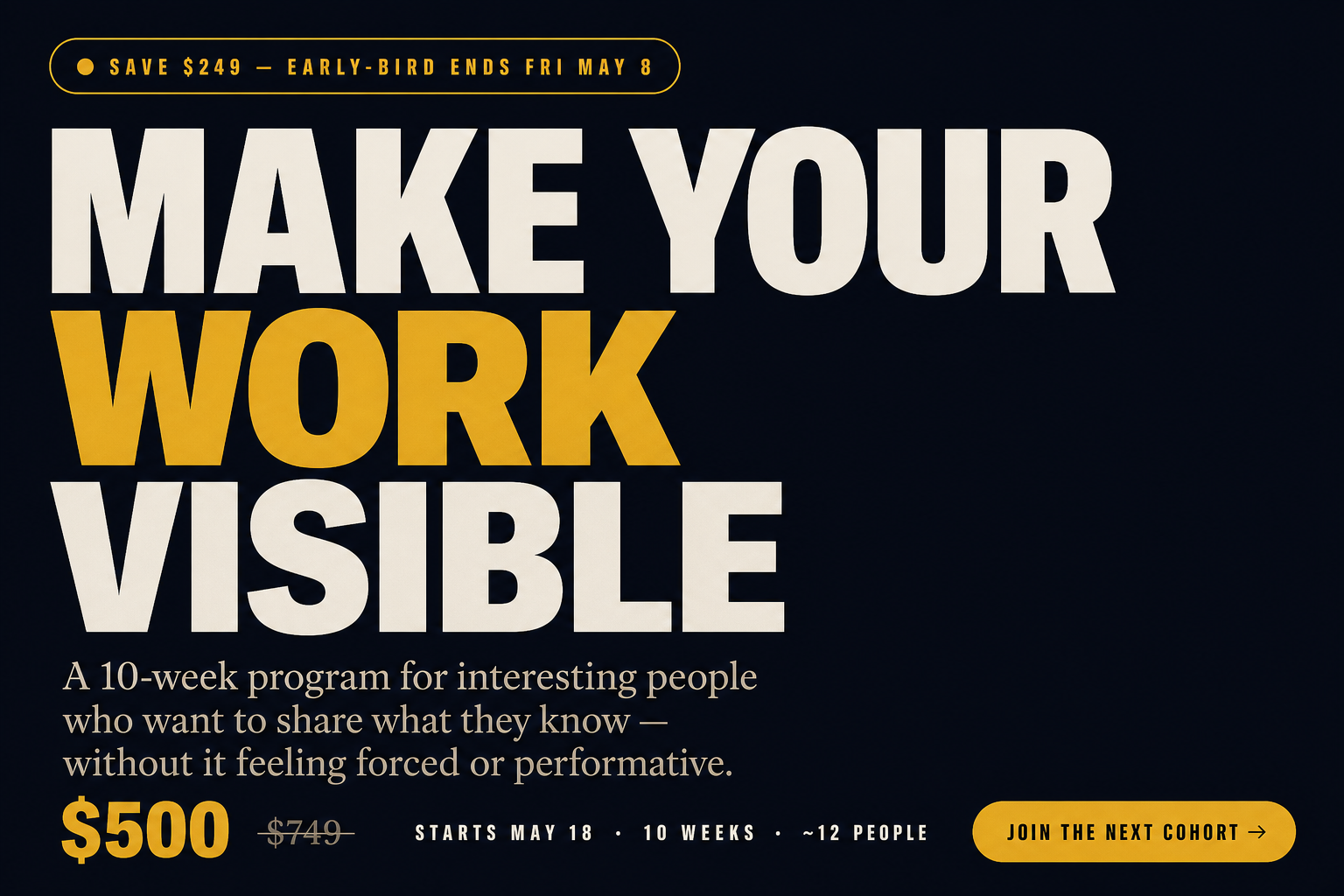
Sign up by Noon tomorrow (May 13th) and I’ll keep the discount open.