Raising Capital for Consumer Products: How to Get the Green If You’re Not a Bear

If you're a consumer founder who's gotten passed on by investor after investor, you've probably been told some version of "You're a little too early for us"—or you've assumed that most VCs just don't understand consumer. There's some truth in that—but mostly if you’re pitching the wrong investors.
It's not the whole story, and honestly, stopping there doesn't help you. The struggle runs deeper. It starts before you ever send a pitch deck.
Most consumer founders bootstrap their way to a first product. They scrape together savings, make a first run, and sell it to people they know. That's admirable—and consumer investors often value that capital efficiency early on. The problem is when you overspend time in the room explaining how you've done a lot with a little and never get to the bigness of what you're actually building. The bootstrapper mindset got you here, but if it's still the loudest thing in your pitch, you're signaling the wrong thing.
So, yes, you need to be able to say in your pitch meeting that one day, you’ll sell $300 million of yogurt, energy drink, or whatever protein infused snack you’re hawking—and not just say it, but lay out the plan.
The first money often makes it worse. While more experienced consumer founders might raise from angels who've seen big outcomes in the category, the average first timer is taking money from folks that haven’t seen the big win. Yes, there are more angels with consumer operating experience than there used to be—but that's mostly true at the top of the market. The longer tail of CPG founders is still raising from friends and family, and that dynamic is actually more treacherous in consumer than in tech.
The average tech founder's circle doesn't pretend to understand enterprise software or the LLMs under the hood, but everyone in a CPG founder's circle eats food, uses skincare, and drinks beverages—which means everyone has an opinion. They think they know something about it because they like it. That confidence leads to messy money: onerous terms, early payback provisions, cap table landmines that will haunt the founder for years. The conversations that come with that money are shaped by people who are optimizing for "please don't lose your savings," not for "here's how you go dominate a market."
By the time a consumer founder is in front of a real consumer investor, they've already internalized the wrong framing.
Then, there's the business selection problem. Consumer founders don't often choose their category because the unit economics are beautiful. They choose it because they love ice cream, their kids had an allergy, or they wanted to share something about their culture, for example. This means they often end up defending economics that were difficult from day one—seasonal, low-margin, capital-intensive, brutally competitive. Passion-driven selection tends to produce another blind spot: founders routinely overestimate the size of the white space they've found and underestimate the credibility of the competitors already in it. Just because a problem is highly relevant in your daily life doesn't mean there's room for a venture-scale business solving it.
Now consider Chad Janis, who built Grüns—a gummy greens supplement—to over $100M in revenue in two years, then hitting $300 million before selling to Unilever for $1.2 billion. That is a genuine big win and what made it possible isn't what many consumer founders want to hear.
Chad didn't come from a passion for greens supplements or a childhood love of gummies. He came from Lazard and Summit Partners, where he spent years as a board observer to DTC brands like Solo Stove, Brooklinen, and Dr. Squatch. He had access to the proprietary financial data of over 300 brands. He knew exactly what best-in-class LTV-to-CAC ratios looked like before he ever launched a product.
He also thought differently about the product itself. The supplement industry's instinct is to optimize the formula—more ingredients, higher doses, clinical strength. Chad's instinct was to optimize for behavior. A nutritionally perfect product that people find too unpleasant to take daily is worth nothing. So instead of building a better greens powder, he asked why people stop taking greens powders—and built something that removed that friction entirely. That's not a marketing insight. That's a strategic one.
And critically, he could answer a question most consumer founders can't: why can this product exist now when it couldn't before? Investors ask this of every tech founder—what changed in the infrastructure, the tooling, the market, that makes this the right moment? Consumer founders rarely have a good answer. Chad had three. Switching from gelatin to pectin created a vegan-friendly base with higher heat tolerance that could actually hold dense, earthy superfoods without turning into sludge. Microencapsulation allowed bitter minerals and botanical extracts to be masked and time-released in ways that weren't previously possible in a chewable format. And advances in low-sugar matrices increased solids density enough to pack 60 active ingredients into a single gummy—something that was physically impossible with earlier formulations. These were genuine technical breakthroughs that made the product buildable in a way it simply wasn't five years earlier. That's the same structural argument a SaaS founder makes when they say "this only works now because of LLMs" or "cloud infrastructure made this unit economics possible."
Consumer founders almost never come in with that argument.
He was equally deliberate about competition. Rather than avoiding AG1—the dominant player in the category—he used them as a foil. He positioned Grüns directly against their "green sludge" reputation, and built around the three things AG1 couldn't easily change: taste, convenience, and price point. He pioneered an 8-count grab-and-go sachet format that required inventing new machinery because nothing on the market could handle it. For the first eight months, that meant 20 people in gloves sitting around a table, hand-packing and clamp-sealing bags. That's not glamorous. But it's what serious operational execution looks like before the flywheel starts spinning—and by the time it did, Grüns was shipping 4 million gummies a day.
Throughout all of it, he ran the business against a single non-negotiable rule: a minimum 3x fully burdened LTV to CAC. Not as a target—as a floor. He refused to acquire a customer who didn't hit it.
In other words, Chad Janis raised like a VC because he was one. And not coincidentally, he's exactly the kind of experienced operator that consumer is less likely to produce on its own—someone who'd been inside the room where the playbook lives before he ever started building.
Now, is prior VC experience the only path? No. Some founders figure it out mid-flight. Some catch a trend early enough that the traction speaks for itself, and they hire their way to operational competence once the flywheel starts. That happens. But I'd rather be a prepared founder who understands the targets and vets their ideas against them than someone who gets lucky once and can't explain why. Lucky is not a fundraising strategy. And it's definitely not a repeatable one.
But there's one more thing worth naming, and it cuts both ways. Tech investors dipping their toes into consumer don't always understand product in the consumer sense. They can't evaluate whether a drink tastes better, whether a formulation is more aligned with what a particular consumer actually wants, whether a brand will resonate.
As Mike Duda of Bullish put it: "VCs are better at figuring out what other VCs might like than what the typical American consumer might."
If they don't like it personally, it's an easy no—which means consumer founders are often being evaluated not on whether their product will win in the market, but on whether it appeals to a room full of people who aren't their customer. Subjective product quality is essentially a non-argument in that room. The only language that reliably works is traction and economics—something that feels like science, not art. The problem is that early consumer founders often don't have enough of either. Consumer products don't go viral the way apps do. Retail distribution doesn't produce the kind of explosive week-over-week growth curves that make a VC's eyes light up. You're selling into a slow-moving, relationship-dependent channel—and not all products have the economics to make DTC work—especially if you only have a single SKU.
So here's the question to ask yourself before you walk into that meeting: Can you lay out a plan that shows you understand what Chad Janis understood going in—the unit economics, the LTV-to-CAC floor, the competitive positioning, the operational realities? Can you articulate the specific success metrics you're aiming for and make a credible case for why you can hit them? Can you explain why this product couldn't have been built five years ago and what's changed? Can you name the companies whose distribution, infrastructure, or consumer behavior shifts have paved the road you're about to drive on?
Or are you just telling them it tastes great and it's less filling?
Because that's the difference between the consumer founders who raise and the ones who don't. Not passion. Not product. Not even traction, necessarily. It's whether you've done the work to turn a great idea into an argument that sounds like science instead of art.
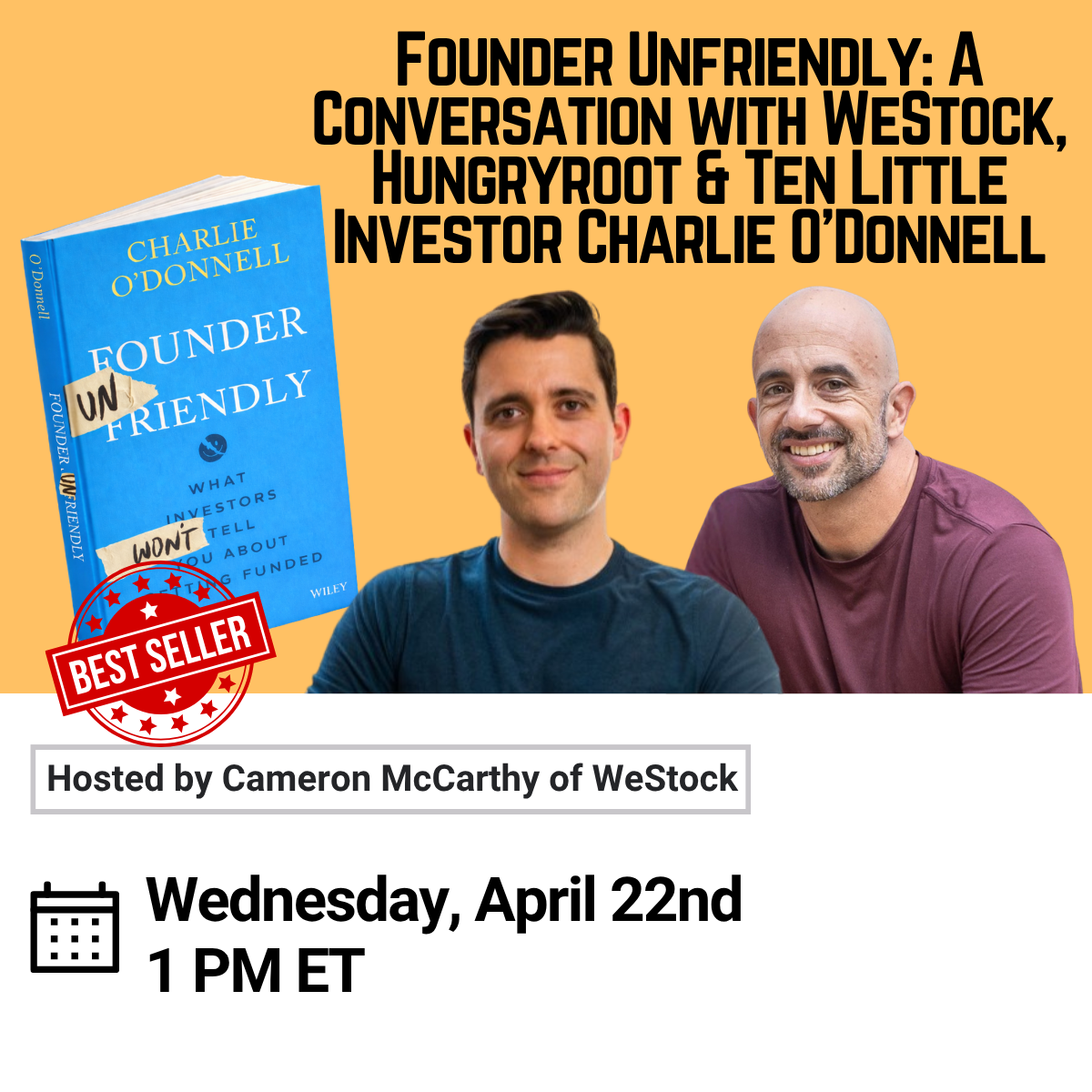
If you want to hear more about how VCs think about consumer products and how fundraising works in general, come listen to my discussion with Cameron McCarthy, founder of WeStock. WeStock helps brands access to a community of consumers who are ready to shop and explore new brands and supports you through ads, data collection, request forms, and rebates. We’ll be talking about my new book, Founder Unfriendly: What Investors Won't Tell You About Getting Funded, the #1 Bestselling Business Entrepreneurship book on Amazon right now.