Top Resume, Top Deal Flow: What You Can Learn from OpenAI’s First Sales Leader Moving to VC
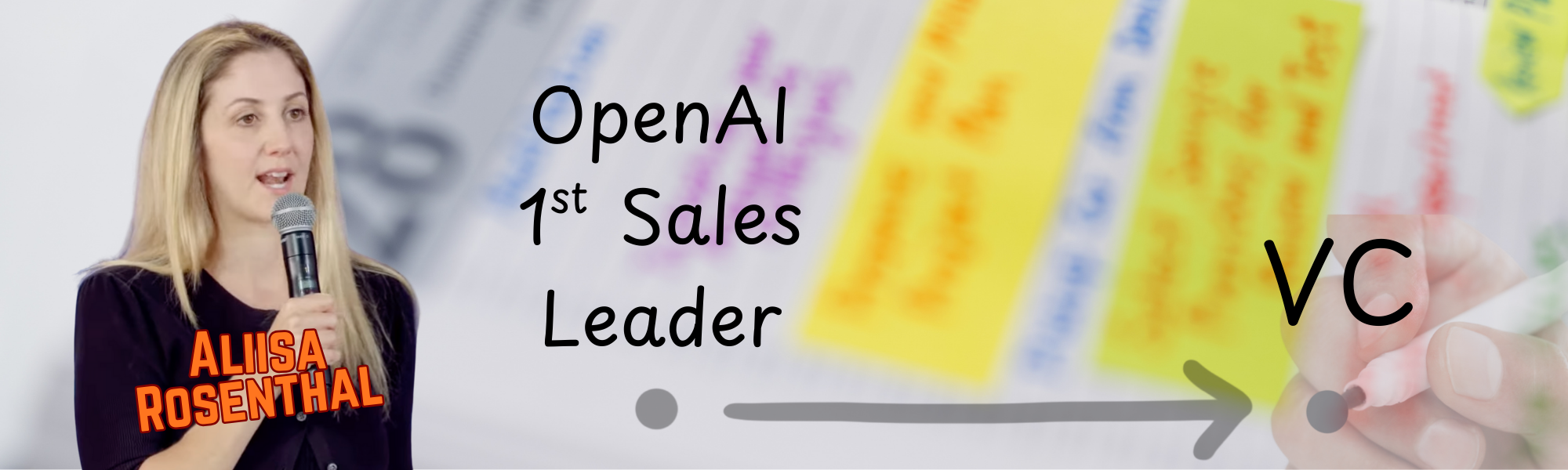
Meet Acrew’s Newest Partner, Aliisa Rosenthal
A lot of my coaching clients have the goal of becoming a Principal or Partner someday. I almost never start by talking about titles. Instead, I ask a different question: three to five years from now, what kind of founders will already want to talk to you before you ever reach out? Not because of where you work or what’s in your bio, but because when they look at your background, they immediately recognize shared experience or unusually deep understanding of a problem they’re actively wrestling with. If you can’t answer that question clearly, the path to becoming a great investor is still mostly theoretical.
A recent example makes this tangible. Aliisa Rosenthal, OpenAI’s first sales leader, recently joined Acrew Capital as a General Partner after helping build OpenAI’s enterprise sales organization from a handful of people into hundreds at OpenAI, generating billions in revenue at unprecedented growth.
If you’re a B2B founder doing early enterprise sales and starting to think about how to scale go-to-market, it’s not just obvious why you’d want to talk to her — it’s almost inevitable. She was a sales leader in the single hottest category right now: enterprise AI. More importantly, she lived the exact transition many of those founders are in: moving from founder-led or product-led motion into building a real enterprise sales organization. That moment — when something is working but not yet systematized — is both the point where founders desperately want experienced guidance and the point where a firm like Acrew often wants to lean in. She doesn’t need to explain why she’s relevant to that stage. Her resume already encodes the overlap between what founders need and what her fund wants to fund.
When I asked her about what her experience enables her to offer founders, she replied "I can really help founders understand the current AI buying landscape - which has changed dramatically over the past few years - to navigate GTM strategy. I can also tap into my vast network of GTM operators to help them land the right initial team."
That’s what I mean when I talk about reverse-engineering your future deal flow. What are you uniquely positioned to help founders with?
Most people intuitively know that some experiences are more valuable than others, but they underestimate how steep the curve actually is. I think about it as a pyramid: a very small number of top-tier, generational experiences at the top, a larger middle of better-than-average experiences, and a broad base of average experiences. If your long-term goal is to work with fund-returning founders, you have to internalize something uncomfortable: those founders will seek out a very small number of people.
Not “someone who has sales experience.” Not “someone who worked in product.” But someone who built a sales team for a breakout company. Someone who led product through hypergrowth. Someone who scaled infrastructure at meaningful volume.
Level-setting matters. You don’t accidentally end up in that top sliver. You either take real risk to pursue a small number of high-potential operating bets, or you become deeply connected to those stories by documenting, studying, and sharing them. Ideally, you do both.
When I zoom out, I see two primary ways people become magnets for great founders. The first is shared experience. You were in the arena. You lived the specific pain: first enterprise customers, first VP hire, first broken process, first time something stops working. This path requires both risk tolerance and selection skill. You’re effectively placing bets on companies early with your career. The real question isn’t “Is this a good job?” It’s “Is this a problem I want to be known for understanding deeply?”
The second path is research and proximity. Not everyone will land inside a generational company early. But you can still build gravitational pull by becoming someone who studies a problem obsessively, interviews the best operators in that domain, synthesizes patterns, and shares what they’re learning in public. Over time, founders start to associate you with a category of insight. You become “that person who really gets X.” That association compounds.
Early in a career, I don’t think the right posture is “future expert.” It’s fast, continuous learner. You signal this by asking thoughtful questions, publishing what you’re learning, interviewing people who are ahead of you, and constantly expanding your knowledge graph. When you join a company, you’re not just bringing your own effort. You’re bringing the people you know, the people you can call, and the people you learn from. That extended network becomes part of your value. Over time, a pattern forms: you become known as someone who can figure things out quickly and knows who to go to. That reputation travels.
Here’s the part most people miss: your resume is quietly turning into a filter. It determines who reaches out, what kinds of conversations you have, and what kinds of opportunities cross your path. You don’t wake up one day and decide to have great deal flow. You build toward it by stacking intentional experiences, credible proximity, and public learning. Years later, it looks inevitable. In reality, it was designed.
I’m not writing this as someone claiming to have “done it right.” I’m writing as a long-time observer of venture careers, watching what compounds and what quietly stalls. I spend a lot of time helping people zoom out and pressure-test their assumptions about what actually leads to being sought after by great founders.
If your ambition is to someday be another firm’s version of Aliisa Rosenthal — someone whose background naturally pulls in a specific class of founders — that outcome isn’t accidental. It’s designed through a series of career choices, learning loops, and positioning decisions that stack over time. If you want a thinking partner to help map that path deliberately, that’s work I enjoy doing in my coaching practice.