Potentially Pregnant? Try Sheep’s Blood: A Real Future Unicorn Pitch a VC Might Have Gotten in 1976
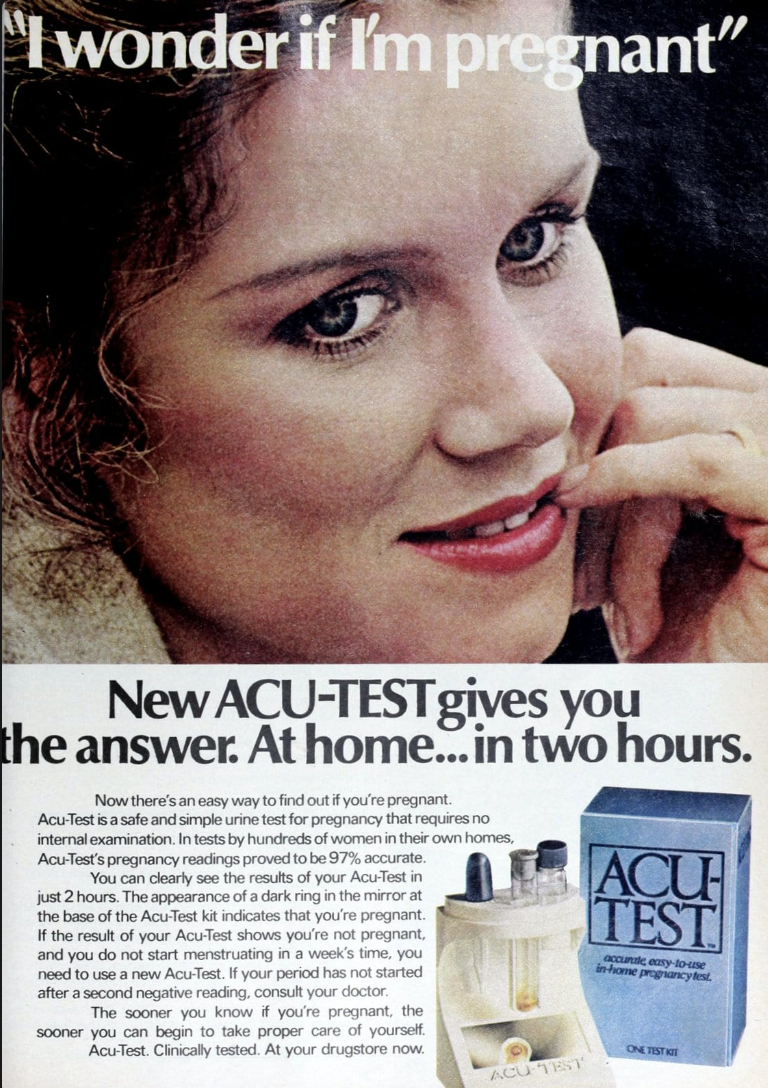
Lately I've been down a rabbit hole on the history of the commercialization of home pregnancy testing.
Yes, a guy looking at this market and sharing insights might feel a little bit like Columbus "discovering" a place where people had been living for thousands of years. 🫣 Bear with me.
You're a VC in 1976, two years before the first at-home test hits American shelves. Here's what you almost certainly get wrong.
You size the market as doctor visits and lab assays. That's where testing happens today. The at-home version looks like a convenience play on a fixed pool of demand — a slice of something that already exists.
You assume one test per event, because that's how the clinical model works.
You listen to the experts, and the experts hate it. Physicians called them dangerous. The worry was that women couldn't be trusted to run the test correctly or handle the answer without a doctor in the room.
You look at the product and you're unimpressed. Fifty dollars in today's money. Two hours to a result. A test tube of sheep red blood cells (yes, it was that baaaaaah-d), a dropper, a vial of purified water, and an angled mirror. Eighty percent accurate on a negative.
You pass, because, in addition to the tiny market, WTF? Sheep's blood?
Every one of those objections is reasonable.
Here's what you missed. The thing limiting how many pregnancy tests got run was never how many women needed one. It was that getting one meant a doctor, a specimen, and a week of waiting.
A 1979 analysis said it plainly: testing at home let a woman keep her doctor out of her sex life.
That demand had never had a way to express itself, so it never showed up in anyone's volume data. The friction ate it before it got counted.
By 1990, women were buying multiple pregnancy tests for every live birth--seven by one UK study's findings. By 1987, a third of American women had used one. Then, ovulation tests landed in 1986 and turned a one-shot diagnostic into something people bought every single cycle.
Nobody in a 1976 investment committee was going to price the privacy or convenience market size correctly. Not because they were stupid, but because they never needed it.
That's why I find Dr. Mariam Elgabry's work with Nurfy so fascinating.
Nurfy is an appliance that runs real microbiology cultures on your kitchen counter in under 18 hours, with swappable cartridges for gut, vaginal, skin, and respiratory.
Lab-grade microbiology, no lab.
Gut health is the ovulation test. Somebody with IBS measures, changes something, measures again, and does that for thirty years. UTI and STI are the pregnancy test — one-off, high price tolerance, because when you find out at 9pm that you have a UTI, nobody's confused about what happens next.
If you underwrite this as a sliver of the lab services market, you'll reach the same conclusion as everyone who looked at a mirror-and-test-tube kit in 1978 and saw a novelty.
The market was never small.
It was locked up like CVS deodorant.