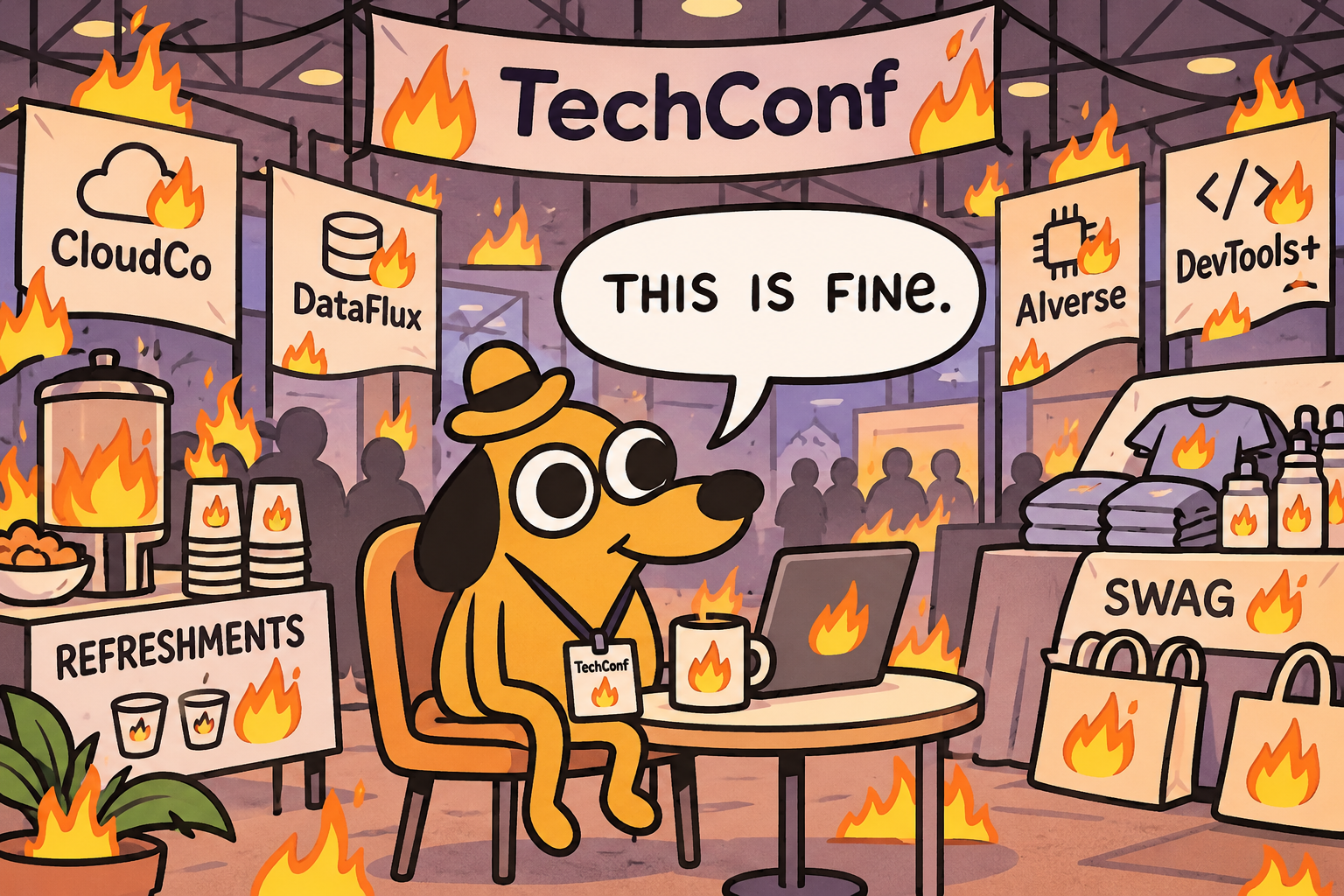
The best sponsors of tech events would do the community a favor if they were collectively plagued by the following crippling insecurity:
"No one wants to talk to us."
"No one wants to spend their social capital introducing us to their most important founder and VC connections."
"Our GTM efforts are a distraction from their real work."
While emotionally draining, it would maniacally drive them to participate in and support only the highest caliber, most valuable events—following those events up with a responsive system of engagement.
The idea that founders’, VCs’ or other C level tech professional’s time is precious should be the core belief driving your tech event sponsorship strategy. Until you realize that you’re but a means to an end, the dollars you spend supporting dinners, conferences, newsletters and all the other valuable connective community tissue in the ecosystem is inevitably going to fail to deliver ROI.
VCs, this goes for you too!
That's because the very best leads--the ones most doggedly focused on performance--have a very high bar for showing up IRL or paying attention to content, as they should. When they're not doing something to build up a fund returning business, they're spending whatever little non-work they have with family or friends or their own mental and physical health.
Can they do it without lawyers, accountants, healthcare for their employees, cap table management software, AI credits, etc? No, of course not--but they wouldn't mind doing that without all the hoops of “relationship building” that you're doing to try to differentiate from your competition. (Or just hanging around the rim waiting for them to be ready to buy.)
When you're planning your engagements, consider how good your roundtable dinner needs to be to score that Series D CFO that just had a new baby. If you're just going to talk about what makes your PEO better than the next one, they're going to take a pass in favor of putting their kiddo to sleep.
If the event isn't delivering incredible value, the drop off in lead quality is going to be precipitous. It's easy to fill a room with folks who are, to put it politely, "aspirational", but most of those folks aren't going to turn into your best clients.
Having spent 20 years in venture and now the last few years focusing mostly on high quality community events that run on sponsorship, here's what I learned about:
1) Getting the right folks in the room.
2) Creating something actually worth attending.
3) Turning that event into new customers if you're the sponsor.
ICP... Yeah, you know me.
There's no event in the world cool enough to make up for a sponsor who can't articulate exactly who buys from them, when they'll be ready and why them versus any other alternative.
That starts with being able to place yourself in the founder's shoes. You can't really believe in your product without really knowing your customer really well--otherwise you wouldn't have complete confidence that they should work with you and your team over anyone else.
That's important because, more than any particular feature and probably more than price, a high potential founder most wants to work with providers who understand where they're coming from--partners who are highly knowledgable about the problems they're facing.
The key is conveying that understanding in a personal way in the most time efficient way possible. Having the opportunity to do so is where community partners come in.
Borrowing Trust
The founders and investors who wouldn't easily take a cold meeting with you will still show up for someone they already know and trust. That's what you're really paying for when you sponsor something: the chance to borrow that trust for long enough to get your initial message out.
Whose trust you borrow matters a lot, because the more valuable the potential client, the higher they value their time and the less easily they hand it out.
Ideally you're borrowing it from someone who works in the industry--someone who built their relationships doing something other than just connecting as a business. That's why sponsoring AGMs has become so popular--because the main business of VCs isn't running events. They have social capital at risk in any room they broker a vendor introduction to.
Similarly, anyone who builds highly curated events--gatherings that don't really scale--is going also have a lot on the line. nextNYC, the continuation of the Brooklyn Bridge Ventures events platform that I run, has been running our Pre-Series A Offsite since 2018. We gather over a dozen VCs to spend a full day with 60 companies. That model doesn't work with more companies, because quality will go down. Lower quality companies wouldn't get us more VCs, so we have an application process to get in--a process that attracted companies like Huggingface, Spring Health and Brigit all before their Series A.
For better or worse, the economics of scale and our reputation aren't aligned--but since I'm not a full time event producer, it doesn't matter. In fact, the trust that others have in the quality of what I work on enables me to monetize in other ways, like coaching VCs and other tech professionals.
What's the story?
Once you put the right people in the room and you know what you have to say, the question becomes what the highest, best and most interesting form of that message.
Why does narrative matter so much? Because the pitch is rarely why anyone buys from a sponsor. When it comes time to pick, the top factor, which has been backed up by research, is a demonstrated understanding of their company's specific challenges.
That's narrative work, and a practitioner, whether a former VC or a founder, can do it better than a professional event producer. They know what founders and investors actually want to hear because they've been on that side of the table. That's why VC-run podcasts and events usually have better panel conversations than tech industry conferences.
Conversely, I put a lot of effort into hosting good panels because I've been to too many tech conferences as a VC where the panel missed the mark and my time got wasted.
That's why if you're going to market something, you need to look beyond the product to what the user feels about what the product covers. When why when we work with Qapita on their cap table management software, we're helping them with webinars like, "10 Ways Founders Give Away Their Equity Without Noticing."
Founders want to hold on to as much equity as possible more than they want to think about cap table software, and the makers of that software can enable that discussion with you to show they get where you're coming from.
The bar is high, but not what you think.
The bar isn't the most famous restaurant. It's not always the most famous person. Our roundtables, where experienced VCs meet up-and-coming VCs, have included folks like Josh Kopelman and Fred Wilson. Those aren't people you normally get in the room unless you're spending (my) social capital.
Sometimes, those big names (not in these two cases, of course) are duds--so it pays to know who's actually got something to say.
One of our best talks was from Liz Zalman, who might not be a household name, but she had written a book about the investment process and I knew firsthand how tenaciously she hustled for her business. I knew the perspective she'd bring to the room and her talk kicked ass.
People still bring that talk up to this day.
This is where sponsors need some self-skepticism. What you find intellectually interesting may or may not be what a VC, founder or CFO finds interesting.
I'm dating myself, but this has to feel like "Must See TV".
Can you think of a better hook than, "At Ramp, our price per million tokens is down about 80% this year. We got there while using a lot more AI"?
I don't know anyone that wouldn't stop and read this post and if I was trying to get the attention of CTOs and CFOs, I'd want to feature discussions with anyone on the Ramp team who made this possible.
Put the right people out front.
Most sponsor teams don't have anybody in charge of story--a brand role.
They also don't have enough people who can talk to a founder as if they were a founder, or even speak from experience as a board member.
Some law firms are good at this. Almost every firm has the one partner who likes going to events and is a great, entertaining talker--but more and more, that's got to be the role of all the partners if they're going to generate new business.
Yet, that person doesn't have time to build community, write a newsletter, etc. Paired with an organizer who does, it's two for the price of one: they get in front of your community, and their content is just as good as yours.
Compare that with putting someone in front of your community who can't write the sponsor post, doesn't know how to participate in the interview, or doesn't engage with an audience on social. That's a little like pushing a rock up a hill.
Who you put on the front line impacts the sponsorship. Don't scramble at the last minute for who is free to show up and rep. Be thoughtful about who represents you best and make that part of their comp and KPIs for the year--not a distraction from what actually gets them their bonus.
Responsiveness counts here too, starting with how you treat the organizer. If you're counting on someone for introductions, you can't have them constantly waiting on you for payment, a target list for new clients, etc. They'll assume that's how you'll treat the client.
Some sponsors get this right. They hop on the phone immediately and jump on every intro, and that matters a lot when you're borrowing someone else's social capital.
All year: repeat it, as a series. One dinner is a one-off. The Series A company that isn't ready to switch law firms today might be ready in three months, and you want something with that message ready to hit them at the right time. That means doing the same structure events on a continuing bases. You also get better at it each time, because you learn from every one. Series matter and they build reputation.
"So and so said you do these talks... I'd like to come to the next one."
That doesn't happen when your dinner is a one-off.
Around every event: cross-pollinate. The event comes with a follow-up piece of content, and that content comes with a small-group follow-up. Now they've seen you across a number of different touch points instead of at one dinner.
You either need to work with an organizer who will keep putting you in front of relevant audiences over the course of a year, or you need a post-event follow-up plan that keeps you top of mind with something better than your nameless, traditional corporate drip mailer. Do your individual key team members have personal newsletters with at least a monthly cadence? Notes that share something engaging, useful and meaningful, not just your annual QSBS review reminder?
After: follow up on what they actually need. This is where most of the value is, and it takes years. A couple of years ago we did a panel with Evvy, which has raised $40 million, and Vendelux, which raised $50 million, right after their Series A. They've gone on to become breakout companies, but, of course, that's multiple years in the making. If you don't have a great CRM and a way to stay in touch and add value, you'll drop the ball on being there when they're ready to consider you.
Ask what their needs are. You might not be able to sell a founder on your banking relationship right now because they're too busy trying to hire a CFO.
Fine. Can you put your recruiting team on finding them a CFO?
Can you work with the organizer to find someone in the CFO network who'd be a great fit? I recently interviewed a founder who mentioned one role that was incredibly hard to hire for. If a sponsor's recruiting team reached out and said, "I'd like to help you hire for this position," I guarantee they'd become a customer.
That's how you win return.
Be clear about whose job this is. When an organizer hands over a relationship, the follow-up is yours. I can't be in your CRM unless you pay me to do that, and most sponsors don't allow access anyway.
I can suggest the play. Running it is up to you.
That's why so many sponsors spread themselves too thin. They spend too much on the top of the funnel and not enough supporting their BD team's ability to convert. I'd rather spend half the sponsorship dollars and twice as much on lead conversion support: tracking the companies you met, responding fast, having good systems. If you meet a founder at an event, do you have a way for what they post on LinkedIn or in their newsletter to turn into tasks you could help with?
Along the way: give your organizer one honest owner. Some sponsors are supportive and great in person, but the team isn't on the same page and nobody says what's working and what isn't. Then the organizer isn't even sure what to do with them. The best version is one person who gets it, often someone who has run an accelerator or a community program, and who gives direct feedback.
That's what lets us adjust as organizers. Two of my sponsors said they felt like they had met enough VCs, but CFOs were the target buyer for them--so we went to work building out a series of events for CFOs. It's been extremely successful--but that only happened because of the feedback.
So before you sign anything for 2027, sit down with your team and map how relationships happen end to end. We meet this person at this stage. Here's their issue. Here's how they interact with us. Here are the five conversations they have with your team. Here's the time of year they convert. That's going to help event organizers build something for you immensely.
Most sponsorships aren't planned that thoughtfully. I'm happy to talk through what I've learned about running events in NYC for 20+ years with anyone who is looking to support them. You can reach me at charlie@next.nyc