Extraordinary claims require extraordinary evidence: How Much Due Diligence is Right?

Remember that time that Trevor Milton rolled a non-working Nikola truck down a hill for a demo video?
How about that time Charlie Javice sold Frank to JPMorgan for $175 million because a bank due diligence team thought they had 4 million users and it turned out they only had 300,000?
Did you ever join the IRL social app? Did you befriend any of the bots that made up 95% of its users before raised $170 million?
Did you know that Jessica Richman of uBiome is still a fugitive, hiding out in Germany?
FTX anyone?
Would your firm’s due diligence process have caught any of these? If you scan a list of venture firms invested in some of the biggest scams, you get a list of investors you’d actually be quite happy to be an LP in—top tier names, in fact.
While the big scams make headlines, as a percentage of all startups, it’s pretty rare, but not nearly as rare as onerous due diligence requirements in venture. I know of at least three firms that my portfolio companies have run into that build 80 to 100 page decks before they will write even a pre-seed stage check.
Two founders, a couple of POCs, no revenue. Other firms can meet the founders and be ready to go while these firms are still working through their process. That's weeks of work on a company that barely has a working demo.
I asked one whether everybody reads the deck. Nope, but turn in something shorter and you get told you haven’t done proper due diligence.
What is proper due diligence in venture anyway? Does any of this actually matter?
And forget about outright fraud. Is there anything you can actually diligence at the seed stage that proves the outcome?
I think it's worth separating out the different kinds of due diligence, because they're not all the same thing and they don't all have the same value.
You obviously want to do what you can to prevent outright fraud. Do you need a full background check to tell if this person is who they say they are? Is there any actual code here? Do they have the number of users they say they do? IP diligence falls in here too — do they actually own what they created — because when those things fall apart, you get an automatic zero and there's no upside to it. It's all downside.
Here's the thing about that, though. Outright fraud in an early-stage deal is exceedingly uncommon, for a couple of reasons. One, for a few million bucks, it's not kicking-it-in-Fiji money, and most people aren't criminals.
Two, in a lot of instances you're dealing with known quantities—people who are diligenceable in your network without a full background check, people you kind of know from around, people you've seen on socials, people you can Google who've spoken at conferences. You at least have some confirmation that yes, this person was in fact the former CTO of Noom or whoever they claim to be. That level of fraud is not only rare, it's easily diligenceable without a lot of effort.
I've also been surprised by what background checks turn up and what people do with it. I was already in a deal once when a later-stage VC ran a check and found a marijuana arrest on one of the founders. I didn't know about it. They started asking questions. It sunk the deal. Our attitudes toward whether somebody with a criminal record is a criminal for life have changed dramatically since I entered the industry. Wire fraud, sure, that might give you pause, but I know people who have felony convictions in their past who I think are changed people. If I liked the idea enough, and thought the plan was great, I'd write them a check.
The second kind is verifying whether the thing is actually a thing. A founder comes to you and says customer A has this problem. In an ideal world, if you invest in the types of companies that solve customer A's problem, you should already know that's a problem, because you should be actively talking to customers already. You do the work ahead of time if you’re playing in this space.
Even if you don't, the founder's background should provide most of your due diligence. Somebody who previously worked in a radiology lab constructing pathways for radiation treatment, who used to have to do the geometry by hand, who says there's no easy way to do this and built software for it, and already has some paying customers? That rings true.
How likely is it that a physicist is oblivious to a market leading solution for this that works?
Where you can actually do diligence on this is on the founder and their homework. If you solved something for yourself, that's one thing. I sit on my co-op board, and I often use Claude to ingest the documents we need to go through, like our insurance quotes. I'm not an insurance expert, but it can point me toward what questions to ask and where to push back. If I think there should be a tool to help boards do that, it doesn't necessarily mean I've talked to any other board members about it.
On the other hand, if I ran the tech committee of an association of young co-op board members — the next generation of home buyers, a group that skews more tech savvy than some of the older board members — and this was an active conversation there, you'd have to imagine I'd done more due diligence on this myself than just scratching an itch that only I have.
You can just ask them. What data indicates that this problem is worth your time? If the answer comes out something like "well, I spend a lot of time on my co-op board and I thought this was a good idea," thinking it's a good idea is not data. Running the session on using AI to help you as a young board member, and having that be the most signed-up-for session at a conference of 500 young board members — that's real, albeit early, data.
I would say this points to venture firms that are high trust versus low trust.
There are some firms that are low trust internally, and therefore externally. If you're the kind of firm that needs 20 customer calls to tell whether someone who's quitting a $400,000 a year real estate executive job to work on this startup is onto something, that's low trust. You just don't imagine that most people act rationally. Which is interesting to me, because as a board member you don't have a lot of control over the company. The idea that you're somehow going to get to a position of high trust just by asking a bunch of questions before you write the check is interesting to me.
Yeah, it's more thorough. It also doesn't value your own time, and it doesn't value the time of the customers you're calling. What you want from a founder should be what you want from yourselves. Would you want a founder spending a bunch of time in their pipeline on leads that are not going to close?
The third kind is market sizing, and I think most of the best VCs would tell you this is impossible. The really huge outcomes are in markets that didn't exist at the beginning of the investment, or the value of a much better product turns out to be far bigger than the value of a product that only does half the job. How do you even size a market… what about when the founder doesn’t even think the market will be as big as it ultimately becomes?
When Minna Song from EliseAI pitched me a leasing automation product, I asked her what the market size was, b/c I didn’t think notoriously stingy real estate owners would pay a lot for this—and I wondered whether there were enough of them, each paying enough, for this to be a big outcome.
Here’s what she wrote:
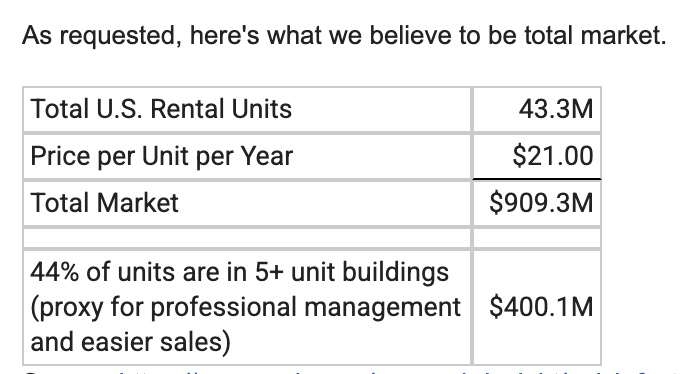
She came out to somewhere around four hundred million dollars. That's just not enough to be venture backable, so I passed.
EliseAI is now a multi-billion dollar company rumored to be raising at a $3.7 billion valuation. Not only did the company generate a much higher ARPU than expected given the numbers that have been made public because the product saved a lot of time, but they're in the healthcare market now.
In hindsight, I should have asked the upside question:
“Assume this to be true. Let's say it does all this work — how many hours could it save your customer, and is your estimation of pricing correct?”
It probably wouldn't be.
It’s one thing when women get downside questions as noted in the HBR study when they’re trying to pitch a big upside, but even if they’re not, “What's the most anyone could ever pay for this?” is probably an exercise worth having when “a team of engineers from MIT and the University of Cambridge” comes pitching.
The fourth way VCs spend a lot of time on diligence is the financial model. Some really pore over every last number like they’re sweeping a crime scene. Yet, the model exercise is always very skewed, because different founders from different backgrounds set their level of conservatism differently. Some people will build you a model where they know they won't go out of business. That's not what is going to happen when the flywheel starts turning.
I’ve come to realize that it really is. A personality test.
If you can sit with the founder and actually explore the upside case, and they're willing to talk through all the possibilities, then a founder who was initially more conservative but shows the willingness and the interest in leaning in once they get data is maybe more thoughtful than just conservative.
There’s also technical and product diligence. If you're doing something deep tech, where you've built something that hasn't been built before, or it's really technically hard, or it needs IP protection, then yes, there's a level of diligence that's probably required, because that's the bet. If that's not the bet, the technical diligence is probably going to tell you that this thing is duct taped together and a good tech team will rebuild it over time. That's not going to give you any definitive answers either.
Too often product due diligence is "do I like these features" when I'm not even the customer. What I think is really useful is whether whoever is running the product is actually close to the customer. Are they moving quickly and iterating fast? Does the product change and update at a high speed through the diligence process? Is that informed by data? That's better product due diligence, because it's diligence on the product brain trust.
The last kind is references. I've been steered wrong by references. I've also experienced in my own network that when people complain about their boss or their teammates or what somebody else did wrong, nine times out of ten there are things I think they could have done better too. Barring things that are injurious to other people, problems at work are often a two-way street, and oftentimes a communication breakdown.
So what are you actually diligencing at seed?
I think it's more like: does the team know how to figure out, or have a pathway to figure out, the thing they have to figure out during this round? Are they likely to spin their wheels on it? You can run out of time very quickly in a seed round. If you have to acquire a bunch of consumers, and no one on the team has that DNA, and they don't have any thoughtful or creative ways of doing it, and they don't have any audiences built in that follow the founders, you can very quickly wind up blowing through a two or three million dollar round struggling to figure out how to cost effectively acquire consumers.
Same goes for anybody selling into governments, small businesses, schools. These are unique types of sales. I don't think founders without that background, or who aren't students of the process — dissecting how to do it and learning from others — will be able to figure it out fast enough.
Later-stage due diligence is different. There's more data and there are more team members to talk with. There's also usually more time. You can get to know a team after their seed, so that by the time you're ready to diligence a $40 million Series A, you've done a majority of your work already, because you've gotten to know the team and the space over time.
The upside is less, too, and the commitment is bigger. You write a bigger check as a percentage of your fund. You're generally expected to commit and support the company. You're paying a much higher price. You're not going to have a 100x off a Series A — I mean, you could, but it's much more likely in the seed, when the valuation is one fifth the amount.
Can Due Diligence Add Value?
What about the firm that wants to be thorough and still win that seed deal, even if it takes longer?
That firm needs to aim to have a due diligence process that definitively adds value.
For example, you guarantee introducing the company to 10 potential new customers who absolutely fit their ICP and are within the firm's network. You have a deep-dive product and financial discussion — a working session that actually makes the founder think differently about the business.
Those are the types of things that don't feel like creating busy work for a 100-page deck. They're a sneak preview of serious board meetings that actually add value.
That’s better than being a firm racing to the bottom of zero due diligence to get the fastest term sheet out.
What I’d say to that firm with the 80 page deck that might be losing deals is this:
Some of that work is worth doing — ahead of time, on the space, before you ever meet the founders, so that it's useful for more than one deal. Maybe before the meeting, you actually send it to the founders… AI could generate it and if you’ve nailed your agents, it might be a useful document for the founders. It could take into consideration all the other meetings, prior research, customer calls, etc. that your firm has already done. (Meaning, it could be new insights to the founder, not just AI slop.)
The rest that isn't telling you anything at the seed stage should be cut. Then you should get to work on finding out whether this team knows what they don’t know and whether they have a plan to figure it out before the money runs out.