
Should I stay or should I go now? A field guide for discouraged founders
“I respect you enough to believe that you should have a really high bar for your own personal investment in this. What data has your company provided you that has earned your time, your money and your emotions?”
This is what I’ve started asking founders as a way to give context to my feedback — because it lands better than, “This won’t work” or “I don’t want to back you.” It gets the founder objectively dispassionately assessing whether they’re a good bet—because it makes them take a look about whether their own bet is based on something tangible.
Otherwise, when a founder gets discouraged, the instinct is to read it as the universe handing down a ruling — the idea is bad, I'm not good enough, time to fold. Sometimes that's true. More often it's noise: bad data that looks like signal, or real data about the wrong variable. The founders who make it aren't the ones who never get discouraged.
They're the ones who can tell which kind they're looking at.

VCs Don’t Care About Your Product
Show me insight. Don't tell me people want healthier alternatives. Tell me what you discovered about the customer that nobody else saw, and walk me through how you got there. This customer needs a smaller version of this. That one doesn't use half the features and would happily pay for a stripped-down option at a different price point. This segment wants flexibility the incumbents refuse to give them. When you can take me down that path—when I can understand exactly why you built what you built—you're not pitching a product anymore. You're pitching your judgment, and judgment is the thing I'm actually buying.
Judgement also gives me the confidence that when customer preferences change or when you pivot the product, that you’ll make the right call.

Sourcing Versus Thinking: Should We Put the Deal Flow Sharing Call to Bed?
Everyday, throngs of mostly junior investors join deal flow calls--regularly scheduled check-ins to "compare notes" on what's out there and being considered.
It's a careful dance. You want good deals back, but you don't want to give away most of your good stuff. You're saving that for better firms than who you're on the Zoom with now.
But wait... Do they think you're the better firm or do they think they are? Are you getting their best stuff or are they just trying to tease you out of yours?
What if you share something you like and they neg it, or worse, they've already passed on it? Are you going to be in your head about it now and suffer from a loss of enthusiasm?
My personal opinion is that these calls are a colossal waste of time.

What is this Financial Model for Anyway?
“…In an instant, the thing exploded into gobs and gobs of thingamabobs.
One by one, the thingamabobs became all of the things we know today ...big things, little things and even very complicated things.
Everything was in its place. Well, everything except for one small, shapeless thingamabob.
No one knew what it was.
And no one was clear what it was for.”
Feels like how some founders holding on for dear life think about their financial model.

What Do Your Startup Advisors Say About You?
The most honest thing you can say about a formal advisor relationship is this:
It's a workaround.
When a founder tells me they need an advisor to open doors in an industry they don't know, or to fill in a knowledge gap they don't have, I hear:
“We don’t know the right people.”

Public Stealth Leaves Opportunity on the Table. Working in Secret is Even Worse.
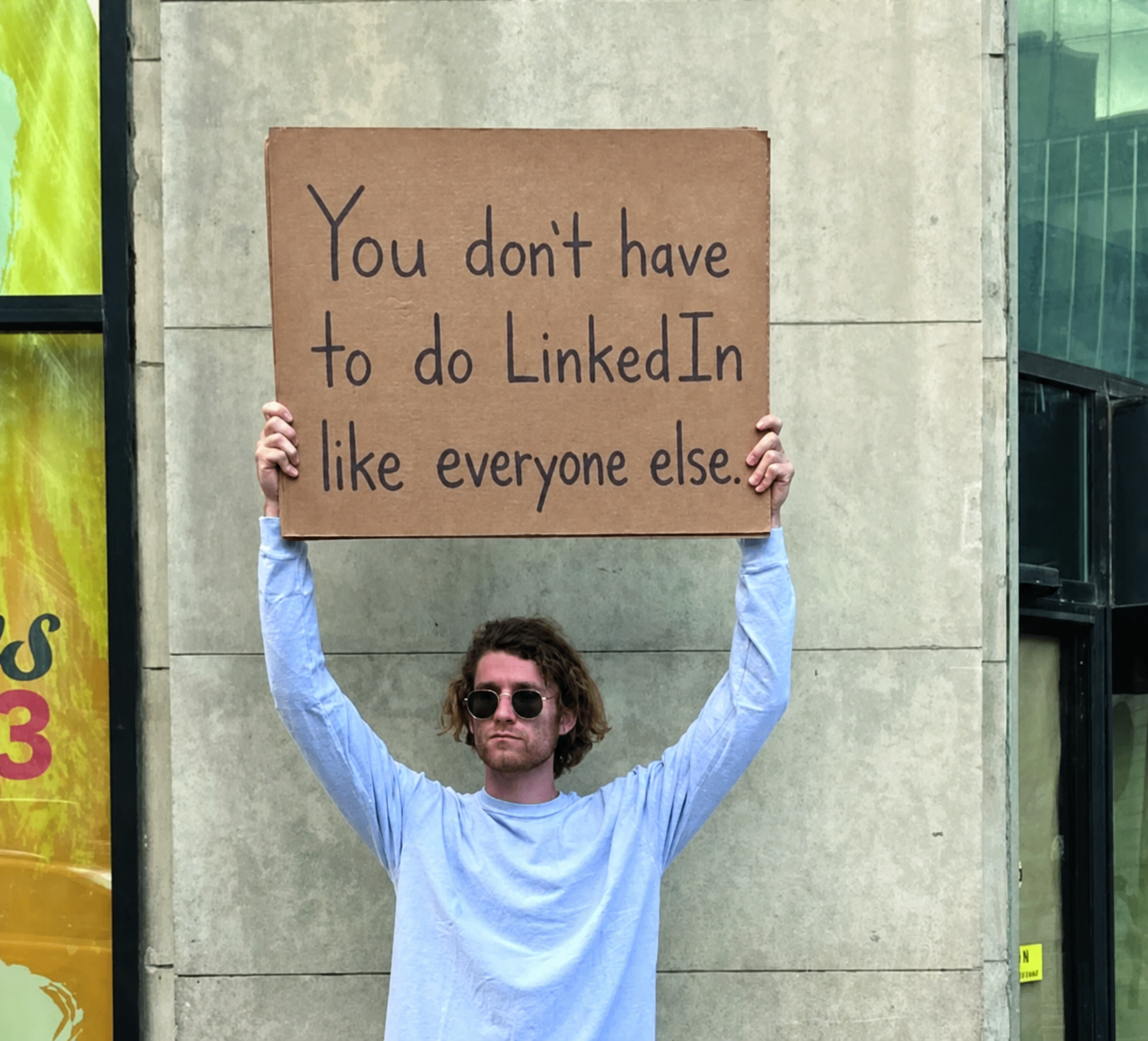
It's the founder whose public profile gives no indication they're working on anything at all — and who is simultaneously applying to things, requesting introductions, trying to get into rooms. I see this constantly. The email is a gmail.com address. The LinkedIn has no mention of any kind of startup. There’s no website for the company — not even a landing page.
That's not stealth. That's confusion. When someone reviews that application, the disconnect between what you're asking for and what your profile shows doesn't read as discretion. It reads as someone who has no idea what kind of competition they’re up against.
The gmail address isn't the problem. The problem is what it signals: You might have thought of this idea today.
How a Routine Reference Check Got Me Booked on a Podcast (Or, Not All Thought Leadership is an Ego Trip)
If you can't think of what to write, the problem usually isn't the writing. It's that you're letting too many interesting conversations pass — or not having enough of them in the first place. You're finding it hard to get inspired to share, because you're not getting inspired enough by others, or you lack the mechanisms to lower the friction to share them when you do.

Your Own Customers Will Disrupt You With AI
Strava's AI just told me I crushed the NYCRUNS half marathon in Brooklyn with my 1:35. It said I “sustained high intensity throughout with impressive heart rate effort.” I got similar feedback when I ran the NYRR NYC Half.
Not true.
In reality I’m in a slow recovery from from a torn proximal hamstring tendon and I haven’t been able to pinpoint why I just wasn’t running at the speeds I wanted to, despite feeling like I’m in good shape. It felt like I had another gear that I just wasn’t able to shift into.
I took my Strava data from these races, along with peak previous performances on the same course, and uploaded it to Claude with the following prompt:
“I would like you to compare two sets of races on the same course... the Brooklyn Half and the NYC Half. 2026 times are after a torn tendon (ischial tuberosity). Is there any insight you have into what's hindering me in this post-tear recovery?”
A minute later, I had charts, insights and the ability to query it further.

Why Bother Writing a Book?
Writing a book demands something different from you than a blog post ever will. When someone pays for your work, you owe them something. You have to think about the full scope of what they need, not just what you feel like complaining about that day. You become accountable. And that accountability forces empathy.
Doing some customer empathy exercises is critical to any successful career. When you write a book, for example, you are forced to think about scope. If someone is going to pay for this, how do I make sure I don't leave them with unanswered questions?
The writing process also trains you in a specific way. Once you're in "sharing mode," you become hyper observant. Every conversation with a founder became research for me. I noticed the questions people actually ask, the confusions they have, the gaps in what's out there.
Training that observational muscle makes you better at everything else you do.

Raising Capital for Consumer Products: How to Get the Green If You’re Not a Bear
f you're a consumer founder who's gotten passed on by investor after investor, you've probably been told some version of "You're a little too early for us"—or you've assumed that most VCs just don't understand consumer. There's some truth in that—but mostly if you’re pitching the wrong investors.
It's not the whole story, and honestly, stopping there doesn't help you. The struggle runs deeper. It starts before you ever send a pitch deck.

Venture Capital Has a Starting Line Problem
I backed a micro-mobility company about six or seven years ago. The company was run by a Hispanic founder. He was gritty, insightful, and every bit as hardworking as anyone I've ever funded. Yet, he struggled to raise. Ultimately, the company went under. Not having enough capital to push product innovation was the biggest issue.
I saw that Joseph Cohen had raised $14.2 million in total for Infinite Machine, with investors including a16z's American Dynamism fund. They’re building what can reasonably be described as Tesla for ebikes. They literally look like a pregnant Cybertruck gave birth to an ebike. I’m told it’s really fun to ride and as a big fan of the Revel scooters, I believe it.
If you’re looking at the two companies, the easy read is: bias. Hispanic immigrant founder couldn't raise, connected white guy from Penn clears double digit millions.
Case closed, right?
I thought it was an interesting example by which to dig deeper into the nature of how bias and capital access works.

Don’t Just Link Me, Bro: A Guide for Students and Early Career Professionals to Network Up the Ladder
I've been doing a lot of talks with students and founders related to my new book, Founder Unfriendly: What Investors Won't Tell You About Getting Funded which is now available for pre-order. (If you enjoy my writing here, please consider buying it now. If you e-mail the receipt to founderunfriendly@next.nyc, I’ll invite you to this amazing AMA series we have with founders from Datadog, Brigit, Zerohash and more…)
Here's how the post-talk networking usually goes: a minority of the people follow up with a LinkedIn invitation, and that's pretty much going to be it. They'll never follow up again. Ten years from now, either one of us will notice the other as a potentially important connection that seems valuable, but we have no idea how we're connected.
That's not a relationship. That's network lint that just gets in the way of a search to find a useful bridge to someone.
There’s a better way to establish yourself as a three-dimensional, memorable professional that adds value and offers a connection from a position of strength, no matter how down the ladder you feel.

Investors: What Have You Built for Me Lately?
Every emerging manager gets asked the same question eventually, usually by an LP who has seen too many pitch decks: “Why do you exist, and what are you genuinely better at than everyone else?”
A thesis and a network are table stakes. Everyone has those. And in a world where founders can get further on less capital than ever before, and where the number of funds multiplied wildly a few years ago, table stakes aren't going to hold up much longer.
The funds that are going to matter are the ones that have built something irreplaceable beyond the checkbook.

Probable Versus Possible: Managing Expectations as a Startup CFO
You’re sitting in a board meeting watching your CEO paint a picture of the next 18 months, and everything they’re saying is…
…not impossible, but...
But you know the assumptions underneath it. And you’re about to have to present the model that’s supposed to back all of it up.
That tension — between what’s possible and what’s probable — is the part of the job you feel your reputation is tied to. Not the spreadsheet. Not the close. The job is being the source of truth in a room that has strong structural incentives to prefer the optimistic read is what causes you the most anxiety.

My Social Graph is Broken So I Have No Idea Who My Friends Are
In 2010, Facebook launched Places. It was their answer to Foursquare.
It failed almost immediately—not because the feature was bad.
The graph was wrong.
When people built their Foursquare networks, they did it knowing exactly what the app was for. A Foursquare friend request meant something very specific: You’d be ok running into this person IRL. Facebook's graph was built for something else entirely—reconnecting with classmates, staying in touch with family, documenting life milestones. By the time Facebook tried to bolt location sharing onto that, nobody wanted to tell their grandmother where they were having drinks on a Tuesday.
The graph had no context. It failed.
What to Do About the Downside Questions Asked of Female Founders
One of the best pieces of fundraising advice I ever gave — and honestly didn't fully appreciate until I said it out loud — came out of a conversation I was having with Lauren Pearl, a CFO advisor who works with a lot of early-stage founders on bias in fundraising.
Specifically, the well-documented phenomenon where female founders get asked disproportionately more risk-focused questions than their male counterparts. The HBR study on this is worth reading. The basic finding: investors ask women "prevention" questions — what could go wrong, how do you protect against downside — and men "promotion" questions — what's the opportunity, how big can this get.
Lauren was making the point that founders who face this kind of bias need to be extra prepared. Have the numbers buttoned up. Be ready to defend the model. Know every assumption. I agree with all of that, up to a point.
Here's where I pushed back: Don't answer the question.

Do you Experience Rejection as a Roadmap or a Flash Flood?
Most of us quietly curate our invitation lists to protect ourselves from the sting of low attendance. We tend not to ask hard questions of people we know won’t go easy on us. We stick to friendlies and narrow the ask to control the outcome. We'd rather invite 10 people and have 8 show up than invite 100 people and have 30 show up — even though the second scenario is objectively better as an outcome (unless you’re an introvert, of course).
The founders who fundraise well tend to have this same quality. They can send 200 cold emails, hear back from 12, meet with 6, and move on without a crisis. They're not deluded — they know most people will say no. They just don't let the no's accumulate into a story about themselves.

Your Cap Table Didn't Kill Your Round
If you got passed on and you're blaming the cap table, I want to push back on that.
I recently hosted a webinar with Qapita, my favorite cap table management software and nextNYC sponsor, with Holly Neiweem, Managing Partner of Apprentice Ventures, and Colin Kirby, who heads the emerging companies and venture capital practice at Foley Hoag. Between them, they've seen it all — 90-investor cap tables, departed co-founders sitting on 40% fully vested, angel investors still on boards three rounds later with no follow-on check to show for it. And their message was consistent: a messy cap table is almost never the actual reason a deal doesn't get done.

The Life of “Little P’s” and Non-Partners: How to Make the Most of the Opportunity
If you’re a junior investor right now, none of this is surprising. You’ve felt it. You send the email and it goes unanswered. You get the meeting, but the founder is clearly waiting for your partner to join, or even explicitly asks. You make the intro internally and someone senior takes over. You’re working hard for the firm, but it’s not clear that your long term value as an investor is accruing.
Are you actually gaining “juice”, or just renting someone else’s?

Are They Still Teaching Air Guitar? Thinking About University Entrepreneurship in the Age of AI
Sixteen years ago, I wrote that, “Business plan competitions are the air guitar championships of the startup world.”
I meant that you can mimic all the movements of a startup without any of the real risk-taking or building. My criticism then was that we were teaching students to pitch without teaching them to build.
Fifteen years later, that gap matters even more. In a world where AI can help anyone ship a working product in a weekend, and where entry-level jobs are disappearing, the ability to actually build something—even something small—isn't just a nice skill to have.
It might be the whole ballgame—and I’m curious how many universities are thinking this way about their entrepreneurship programs